
Please Choose Your Language
Views: 280 Author: XS Traffic Facilities Publish Time: 2026-09-25 Origin: Site


Content Menu
● How Do the Two Signal Types Work?
● LED vs. Incandescent Traffic Signals at a Glance
● Energy Consumption and Operating Cost
● Service Life and Maintenance
● Visibility, Glare, and Road Safety
● Weather and Environmental Performance
● A Practical Five-Year Cost Example
● What Should Buyers Verify Before a Retrofit?
>> Specify Verifiable Performance, Not Just a Lifespan Claim
● Traffic Signals vs. LED Traffic Warning Lights
>> Are LED traffic signals cheaper than incandescent signals?
>> How long do LED traffic signal modules last?
>> Can LED traffic signals improve intersection safety?
>> Can any LED module replace an incandescent traffic signal bulb?
>> Are LED signals suitable for snowy locations?
Choosing between LED traffic signals and incandescent bulb signals involves more than comparing electricity bills. A traffic signal must communicate clearly to drivers, operate reliably in local conditions, and remain practical to maintain over its service life. For road authorities, contractors, and facility managers, the best choice is the one that meets the project's technical requirements at a reasonable total cost.
LED technology has substantial advantages in energy use and service life. Still, an LED module is not automatically suitable for every existing signal head, and a flashing LED traffic warning light is not the same product as a vehicle traffic signal. Understanding those distinctions helps buyers avoid unsuitable purchases and plan more reliable installations.

An incandescent traffic signal uses a bulb with a heated filament. Light passes through the signal's optical assembly to form the colored indication that drivers see. When the filament fails, the bulb must be replaced.
An LED traffic signal uses light-emitting diodes and electronic components to produce the indication. LED products are commonly supplied as modules designed for a particular indication, such as a red circle, green arrow, or pedestrian symbol.
The important point is that buyers should assess the complete installed indication, not the light source alone. The module, lens, housing, viewing angle, and electrical system all influence how the signal performs.
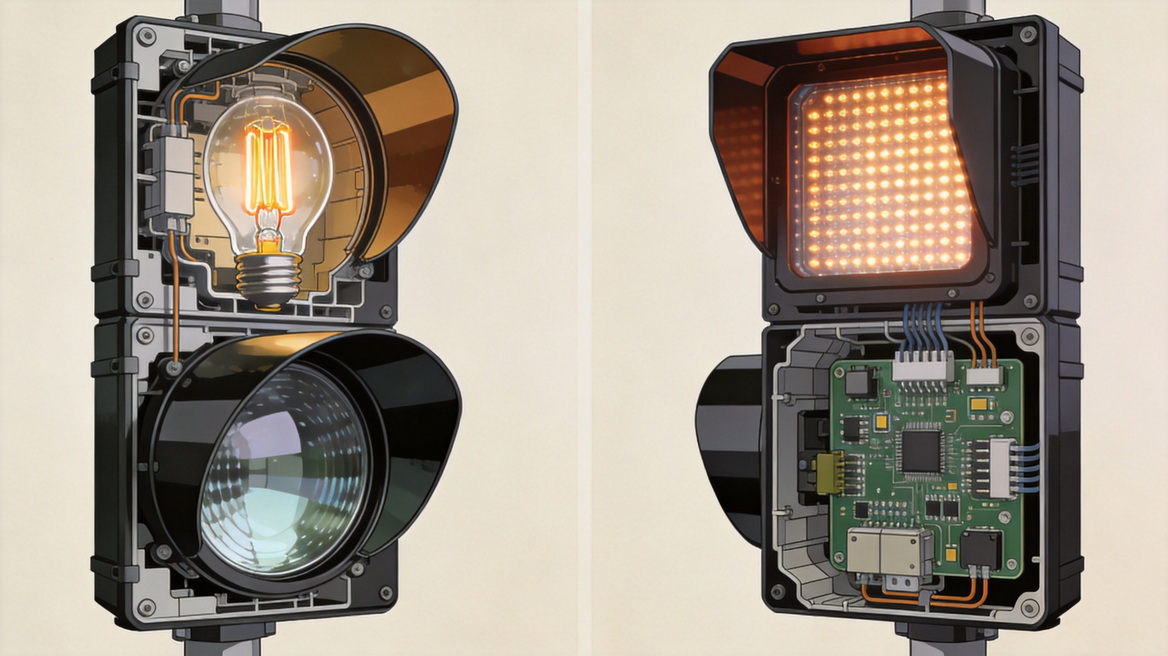
| Factor | LED traffic signals | Incandescent bulb signals |
|---|---|---|
| Energy use | Generally much lower | Higher electricity demand |
| Light-source service life | Generally longer, although output can decline over time | Shorter bulb-replacement cycle |
| Routine maintenance | Fewer light-source replacements; inspections are still necessary | More frequent bulb replacement |
| Initial purchase | Typically higher for a comparable replacement module | Individual bulbs typically cost less |
| Visibility | Depends on module performance, installation, and viewing conditions | Depends on bulb condition and optical assembly |
| Cold-weather considerations | Lower heat output may allow snow or ice to remain on the signal face | Bulb heat may help clear accumulation |
| Buying decision | Evaluate compatibility, documented performance, and lifetime cost | Evaluate purchase price alongside energy and maintenance costs |
These differences describe the technologies broadly. Actual performance depends on the specific product, its installation, operating conditions, and maintenance.
Lower energy demand is one of the clearest reasons to consider LED traffic signals. An LED module can deliver a recognizable indication while drawing substantially less power than an incandescent installation. Across many indications and years of operation, that difference can become a significant operating-cost saving.
However, advertised wattage savings are not the same as project savings. A realistic estimate needs four inputs:
- The measured or specified power draw of each existing indication.
- The power draw of the proposed replacement module, including its electronics.
- The number of hours each indication is illuminated.
- The local electricity price.
Red, yellow, green, and arrow indications do not necessarily operate for the same number of hours. A toll-lane signal may also have a different operating pattern from a signal at a conventional intersection. Calculate each indication separately when the project is large enough for those differences to matter.
Lower power demand can benefit a site with backup power. If the entire system is properly designed for battery operation, reducing the load from signal indications may help extend its operating period. LED modules do not provide backup power by themselves; the controller and other required equipment still need an appropriate power source.
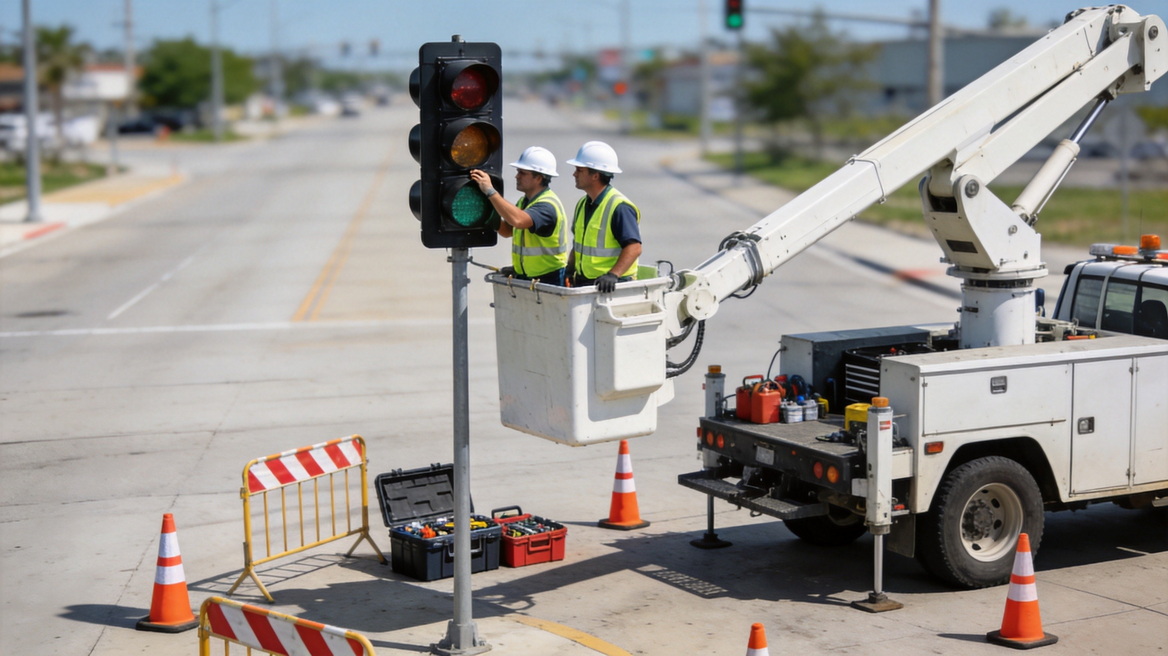
Incandescent bulbs require routine replacement because their filaments eventually fail. At a busy site, the cost of a replacement bulb may be small compared with the labor, access equipment, and traffic management needed to reach it.
LED modules generally reduce the frequency of light-source replacement. This can be particularly useful at complex intersections, highway approaches, and toll facilities where maintenance work is disruptive. Fewer scheduled replacements may also give maintenance teams more time for inspections and other work.
But a longer service life does not mean maintenance-free operation. An LED module can remain illuminated while its light output gradually declines. Dirt on a lens, damaged components, moisture intrusion, or electrical faults can also affect an installed signal. A maintenance plan should therefore address performance over time, not merely whether the indication turns on.
When reviewing supplier claims, ask what "service life" means. Is it a figure for an individual LED component, a laboratory projection, a warranty period, or the expected useful life of the complete outdoor module? These are different measures. Request the warranty terms and any performance information relevant to the exact model being offered.
Both technologies must provide indications that road users can recognize under the conditions in which they operate. A signal may be viewed from an angle, against strong sunlight, or in darkness. Its appearance in a straight-on product photograph does not show how it will perform at every approach.
LED modules can offer strong visibility, but more apparent brightness is not always better. Excessive nighttime intensity may cause discomfort, while an unsuitable viewing pattern may make an indication less effective from a particular lane or approach. Color, contrast, positioning, and the condition of the signal face also matter.
It is tempting to assume that changing to LEDs will automatically reduce crashes. That is too simple. Research on conversions has reported benefits for some crash types and locations, but results have varied. Road design, driver behavior, signal timing, and other site conditions also influence safety outcomes.
A more useful question for procurement teams is: *Will the proposed signal provide the required indication throughout its intended service period at this specific location?* Answering it requires appropriate product documentation and careful consideration of the installed environment.
Weather introduces trade-offs that a basic energy comparison can miss. Incandescent bulbs release more heat, which may help clear snow or ice from a signal face. LED modules produce less heat, so snow-prone installations need particular attention to obstruction risks.
That does not mean incandescent technology is automatically preferable in cold climates. It means the buyer should assess the complete signal-head design and the maintenance response for severe weather. Housing shape, visor design, orientation, and inspection practices may all affect how quickly an obstructed indication is identified and addressed.
For any outdoor installation, ask how the proposed product is intended to perform under the project's expected temperature and environmental conditions. The answer should relate to the specified model and installation—not just a general statement that LEDs work outdoors.
Consider a simplified facility with 100 frequently used signal indications. Assume each existing incandescent installation draws 70 watts when illuminated and a compatible LED replacement draws 10 watts. If each indication operates for an average of eight hours a day, the reduction is 60 watts per indication.
The estimated annual electricity saving is:
100×0.060 kW×8 hours/day×365 days=17,520 kWh.
At an illustrative electricity price of $0.15 per kWh, that equals $2,628 per year, or $13,140 over five years before changes in rates or operating hours.
This is an example, not a forecast for a particular installation. To calculate the full five-year cost, add purchase and installation expenses, then account for electricity, maintenance visits, replacement parts, inspections, and any required system upgrades. A low initial price can be less attractive if it leads to more service visits or higher electricity bills.
For a real intersection, avoid treating every indication as though it runs for eight hours a day. Use its actual or estimated operating pattern, and record the assumptions so the calculation can be checked later.
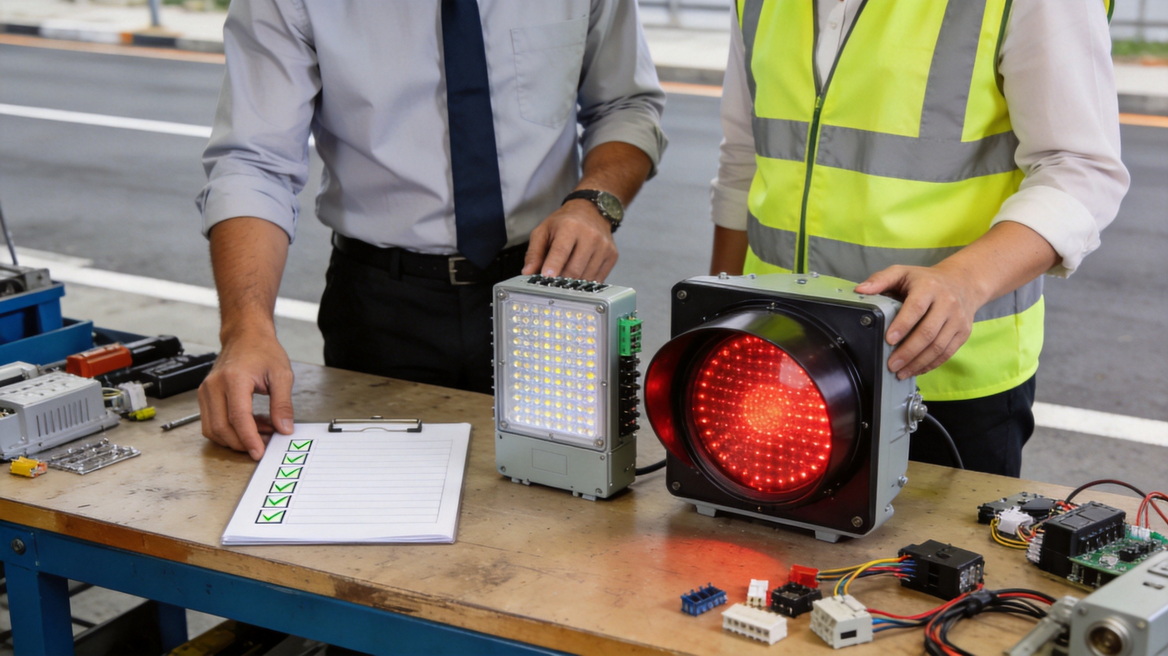
Replacing an incandescent signal with an LED product should be treated as a system decision, not simply a bulb swap. A module that appears to fit may still be unsuitable for the signal head, electrical equipment, or required indication.
1. Document the existing installation. Record indication type and size, housing details, supply voltage, controller information, and site conditions.
2. Identify the applicable requirements. Establish the rules and product-performance criteria for the destination market and project. Do not assume that a specification used in one country applies in another.
3. Request documentation for the exact model. Ask for relevant test information, electrical characteristics, environmental ratings, warranty terms, and product identification details.
4. Check compatibility. Have a qualified traffic-signal professional assess the proposed module against the existing head and electrical system, including monitoring and backup-power arrangements where relevant.
5. Test a representative installation. Inspect the indication from relevant approaches in daylight and darkness, and under local weather conditions when practical.
6. Plan ongoing inspections. Keep a record of installation dates, model numbers, and maintenance findings so future replacement decisions are based on evidence.
A short pilot can be especially valuable before a large order. It creates an opportunity to find unexpected installation or viewing issues while they are still manageable.
A purchasing specification becomes stronger when it describes what the supplier must demonstrate. Instead of requesting "long-lasting LED traffic lights," identify the required indication, size, electrical characteristics, operating environment, and supporting documentation.
Ask the supplier to distinguish between the rated life of an LED component and the useful life of the complete module. Also confirm how the supplied product can be traced to its documentation. These steps make it easier to inspect deliveries, evaluate warranties, and manage replacement schedules.
If the project requires customization, agree on the finished configuration before treating a standard-model report as evidence for it. Changes to the housing, optics, electronics, or other relevant parts may affect which documents are applicable.
The term "traffic light" is sometimes used for products with very different purposes. A red–yellow–green vehicle traffic signal controls movements at an intersection. A flashing LED traffic warning light alerts road users to a hazard, work area, or other condition. Buyers should not assume that a product intended for one role can perform the other.
Shenzhen Xingsheng Traffic Facilities Co., Ltd. is a Chinese manufacturer focused on LED traffic warning lights and other traffic-safety products. Its OEM and ODM services can support projects for streets, highways, toll stations, and parking areas. For any inquiry, clearly identify whether the application calls for a warning device, a controlled vehicle signal, or another traffic-safety product.
That clarification helps suppliers respond with a suitable product rather than a superficially similar one. Include the installation setting, power supply, environmental conditions, quantity, destination market, and any customization requirements in the initial project brief.
For many properly specified installations, LED traffic signals offer the stronger long-term choice because they consume less electricity and generally require fewer routine light-source replacements. Incandescent signals may have a lower immediate replacement cost, but that price should be weighed against ongoing power and maintenance expenses. Neither choice should bypass checks for visibility, compatibility, weather exposure, and applicable project requirements.
If you are sourcing LED traffic warning lights or related traffic-safety products for a street, highway, toll station, or parking facility, share your application and technical requirements with Shenzhen Xingsheng Traffic Facilities Co., Ltd. Request specifications and supporting documents for the proposed product before placing an order.
LED modules often cost more upfront than replacement incandescent bulbs. They can cost less over their service life because they use less electricity and usually require fewer routine light-source replacements. The outcome depends on product pricing, local energy rates, labor costs, and operating hours.
There is no single lifespan that applies to every module. Product design, operating conditions, and maintenance all matter. Because an LED module may continue to light while its output declines, inspections should consider performance as well as whether the module turns on.
They may improve some aspects of signal operation, but converting to LEDs does not guarantee fewer crashes. Safety outcomes depend on the site, installation quality, visibility, signal timing, and other road conditions. Evaluate claims against the specific project.
No. The proposed module must be suitable for the required indication and compatible with the existing head and electrical system. Buyers should also check the applicable product-performance and jurisdictional requirements before approving a retrofit.
They can be used in cold environments, but their lower heat output may allow snow or ice to remain on a signal face. Assess the full installation and establish an appropriate inspection and clearing plan for locations where accumulation is likely.
1. Federal Highway Administration. [*Safety Evaluation of Converting Traffic Signals From Incandescent to Light-Emitting Diodes*]. FHWA-HRT-13-070, 2013.
2. Missouri Department of Transportation. [*Life Expectancy Evaluation and Development of a Replacement Schedule for LED Traffic Signals*]. 2011.
3. Institute of Transportation Engineers. [*LED Traffic Signals*]. Overview of LED traffic-signal module specifications.
4. Federal Highway Administration. [*Manual on Uniform Traffic Control Devices for Streets and Highways*].
5. U.S. Environmental Protection Agency, ENERGY STAR. [*Program Requirements for Traffic Signals: Eligibility Criteria, Version 1.1*]. Archived specification.
6. Eustace, Deogratias, Valerie E. Griffin, and Peter W. Hovey. ["Analyzing the Effects of LED Traffic Signals on Urban Intersection Safety."] *ITE Journal*, 2010.


