
Please Choose Your Language
Views: 252 Author: XS Traffic Facilities Publish Time: 2026-09-08 Origin: Site


Content Menu
● What Is an LED Embedded Flashing Sign?
● Why LED Flashing Signs Matter
● Best Applications for LED Traffic Signs
>> LED Flashing STOP Signs at Unsignalized Intersections
>> LED Curve Warning Signs on Highways and Ramps
>> LED Pedestrian Crossing and School Zone Signs
>> LED Traffic Signs for Toll Plazas
>> LED Signs for Parking Facilities
>> LED Signs for Industrial Facilities and Logistics Parks
● How to Identify the Right Location
>> Review Crash and Near-Miss History
>> Check Visibility and Road Geometry
● Selecting the Right LED Traffic Sign
>> LED Traffic Sign Specification Checklist
● Power Options for LED Flashing Signs
>> Solar-Powered LED Traffic Signs
>> AC-Powered LED Traffic Signs
● Maintenance and Long-Term Performance
● Customized LED Traffic Signs for Global Projects
>> What is an LED embedded flashing traffic sign?
>> Where are LED flashing STOP signs most effective?
>> Can LED traffic signs be solar powered?
>> Are LED traffic signs suitable for parking garages?
>> Can LED traffic signs be customized?
LED embedded flashing signs work best in locations where drivers may not notice, understand, or respond to a conventional traffic sign early enough. These high-visibility traffic safety products are commonly used at unsignalized intersections, sharp curves, pedestrian crossings, toll plazas, parking facilities, work zones, logistics parks, and industrial roads.
For road authorities, contractors, distributors, and facility managers, LED traffic signs offer a practical way to reinforce important messages such as STOP, YIELD, SLOW DOWN, pedestrian crossing, curve warning, lane guidance, and speed control. The additional flashing LEDs help the sign stand out in low-light conditions, bad weather, visual clutter, and other challenging environments.
Shenzhen Xingsheng Traffic Facilities Co., Ltd. manufactures LED traffic signs and traffic safety products for streets, highways, toll stations, parking areas, industrial facilities, and export projects. We support OEM and ODM requirements for customized sign sizes, LED layouts, flashing modes, power systems, languages, symbols, mounting structures, packaging, and private-label projects.
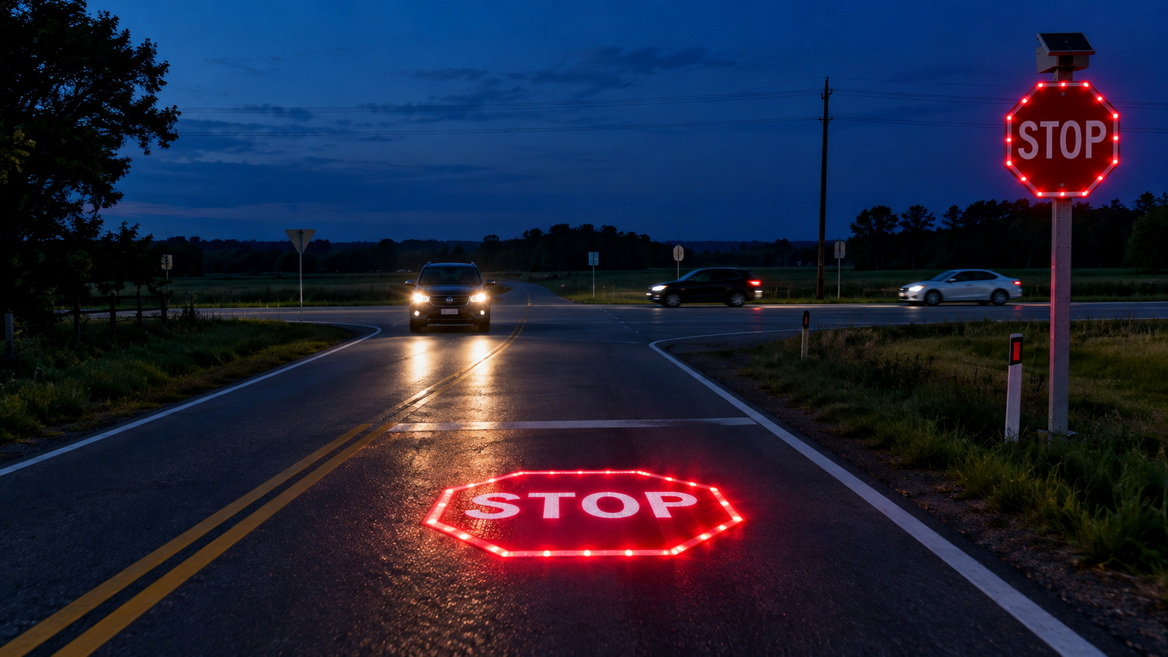
An LED embedded flashing sign is a traffic sign equipped with LED lights around its border, symbol, legend, or designated warning area. The LEDs flash together or according to a programmed mode to make the sign more noticeable to approaching road users.
A standard retroreflective traffic sign relies primarily on vehicle headlights or nearby street lighting to remain visible at night. An LED enhanced traffic sign adds an active source of light, making the message easier to identify in situations where passive reflection alone may not be enough.
LED embedded flashing signs are designed to improve sign conspicuity. In practical terms, conspicuity means helping a driver notice a sign quickly enough to make a safe decision.
Common LED traffic sign types include:
- LED flashing STOP signs
- LED YIELD signs
- LED pedestrian crossing signs
- LED school zone signs
- LED curve warning signs
- LED chevron alignment signs
- LED speed limit signs
- LED toll plaza warning signs
- LED parking entrance and exit signs
- LED lane-control signs
- LED work zone warning signs
- LED wrong-way and do-not-enter signs
The value of an LED traffic sign is not simply that it contains lights. A well-designed sign must combine clear messaging, appropriate brightness, durable materials, reliable power supply, weather protection, and easy maintenance.
Drivers make mistakes for many reasons. They may be distracted, unfamiliar with the road, driving too fast, dealing with darkness or rain, or approaching a location where the traffic condition is unexpected.
In many cases, a conventional sign is present but does not receive enough attention soon enough. The driver may see the sign late, misjudge the road layout, fail to reduce speed, or continue through an intersection without fully stopping.
LED embedded flashing signs can help address this problem by creating a stronger visual warning.
They are especially useful when a driver needs to:
- Notice a STOP or YIELD sign earlier
- Slow down before a sharp curve
- Identify a pedestrian crossing
- Recognize a lane closure or roadway change
- Avoid entering a restricted or wrong-way lane
- Navigate a toll plaza, parking facility, or industrial site
- Respond to a warning sign during nighttime or poor-weather conditions
Studies of LED flashing STOP signs and flashing beacon treatments have reported improvements in stopping behavior and reductions in certain crash types, especially right-angle crashes at stop-controlled intersections. However, LED signs should be selected based on actual site conditions rather than treated as a universal solution.
A flashing sign is most valuable when it solves a clear visibility, recognition, or compliance problem.
Unsignalized intersections are among the most common and effective locations for LED flashing STOP signs. These intersections can be found on rural roads, local streets, industrial access roads, residential areas, low-volume highways, and commercial developments.
A STOP sign may be difficult to recognize when the approach road is straight and fast, when the intersection is hidden by vegetation, or when drivers do not expect cross traffic. At night, the problem can become more serious because drivers may have less time to understand the roadway ahead.
An LED flashing STOP sign can make the stop-control point much more noticeable before the driver reaches the intersection.
The following conditions may indicate that an LED STOP sign is appropriate:
- Repeated rolling stops or stop-sign violations
- Right-angle crashes involving cross traffic
- High approach speeds
- Poor nighttime visibility
- Limited sight distance
- Dense roadside advertising or visual clutter
- Obstructed signs caused by trees, parked vehicles, or roadside objects
- A hidden intersection on a hill, curve, or rural road
- A newly developed area where drivers are still unfamiliar with the traffic pattern
- Rain, fog, snow, dust, or glare that reduces sign recognition
For example, a rural side road may approach a major highway at a slightly angled intersection. Drivers on the minor road may see the highway late, especially after dark. A properly positioned LED flashing STOP sign can reinforce the need to stop before entering the main traffic stream.

Curves are another important application for LED traffic signs. A curve may appear safe during daytime conditions but become difficult to read at night, in rain, or when a driver is unfamiliar with the road.
Sharp horizontal curves, downhill sections, freeway ramps, mountain roads, bridge approaches, lane transitions, and narrow roadways can all create situations where drivers need earlier and more visible warning.
LED curve warning signs can help drivers recognize the road alignment before entering a hazardous section. They may be used together with flashing chevron signs, advisory speed signs, raised pavement markers, delineators, guardrails, and high-performance reflective sheeting.
Suitable products for curve and ramp applications include:
- LED curve warning signs
- LED chevron alignment signs
- LED advisory speed signs
- LED merge warning signs
- LED lane-drop signs
- LED truck rollover warning signs
- Solar-powered LED delineators
- LED narrow bridge warning signs
- LED downhill grade warning signs
A single LED warning sign may improve awareness, but a complete system often delivers better results. For example, a sharp curve on a rural highway may require advance warning signs, speed advisory signs, LED chevrons, pavement markings, and roadside delineation.
Pedestrian areas require clear and highly visible traffic control because drivers must recognize both the sign and the possibility of people entering the roadway.
LED pedestrian crossing signs and LED school zone signs can improve warning visibility near schools, hospitals, transit stops, shopping districts, parks, tourist areas, residential streets, and mixed-use developments.
These signs may be especially useful where:
- Pedestrian activity changes by time of day
- The crossing is not expected by approaching drivers
- Traffic speeds are relatively high
- Street lighting is limited
- Children, elderly pedestrians, or people with disabilities regularly use the crossing
- Vehicles frequently block the view of crossing signs
- The crossing is near a bus stop, school gate, parking entrance, or commercial access point
LED school-zone signs can be programmed to operate during arrival and dismissal periods. LED pedestrian crossing signs can also be combined with solar power, push-button activation, radar detection, or wireless synchronization, depending on the project design and local requirements.
The best design should make the crossing easy to understand without overwhelming drivers with unnecessary flashing lights.
Toll plazas are complex driving environments. Vehicles may need to slow down rapidly, choose the correct lane, follow payment instructions, avoid closed lanes, and navigate around staff, barriers, service vehicles, or maintenance activities.
LED traffic signs can improve visibility and reduce confusion at toll stations by highlighting:
- Toll lane entrances
- Lane closures
- Electronic toll collection lanes
- Manual payment lanes
- Truck-only lanes
- Height restrictions
- Speed limits
- Emergency lanes
- Directional arrows
- No-entry warnings
- Lane merge instructions
- Maintenance or temporary traffic conditions
At night, LED signs can help drivers identify the correct lane earlier and reduce sudden lane changes near the toll plaza. This can be particularly valuable for freight traffic, unfamiliar drivers, and large vehicle operators.
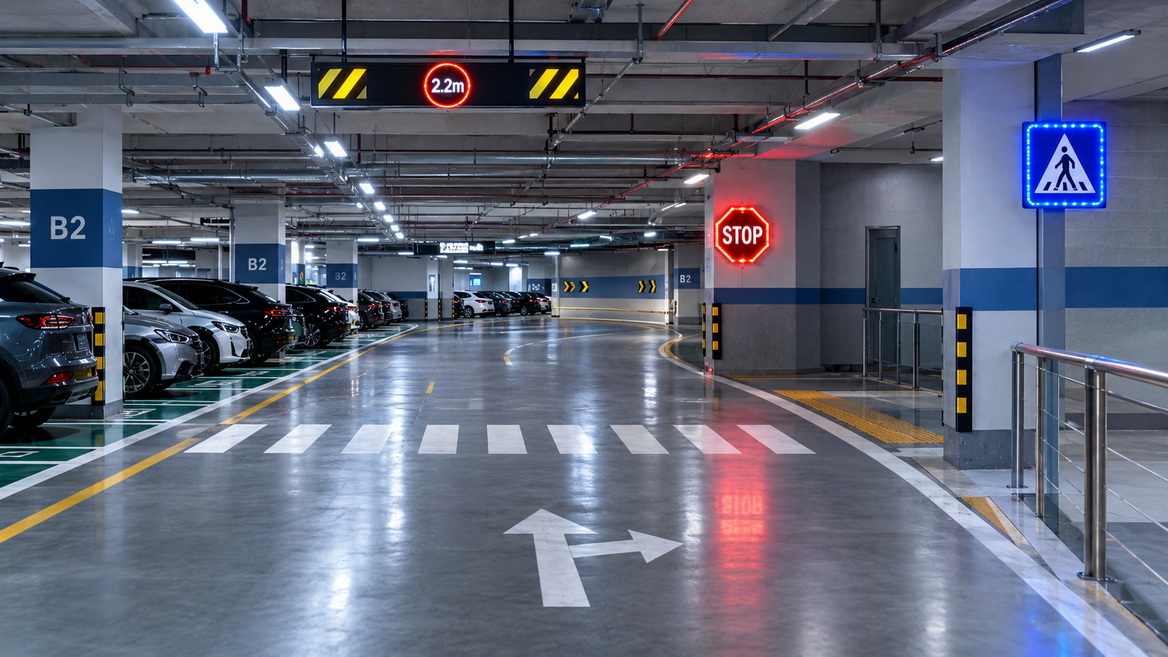
Parking facilities often have narrow lanes, low ceilings, vehicle-pedestrian conflicts, blind corners, one-way circulation systems, and frequent stop-and-go movement. Drivers may also be distracted while searching for entrances, exits, available spaces, payment areas, or pickup zones.
LED parking traffic signs can improve circulation and help create a safer, more organized facility.
Typical applications include:
- LED STOP signs at ramp exits and blind corners
- LED speed limit signs in underground parking garages
- LED pedestrian crossing signs near elevators and entrances
- LED height-limit warning signs
- LED one-way signs
- LED parking entrance and exit signs
- LED no-entry signs
- LED directional signs for available parking areas
- LED loading zone and restricted-area signs
- LED electric vehicle charging area signs
For multi-level car parks, clear LED directional signs can reduce driver confusion and improve the overall user experience. Bright but controlled illumination is important because excessive brightness can create glare in enclosed environments.
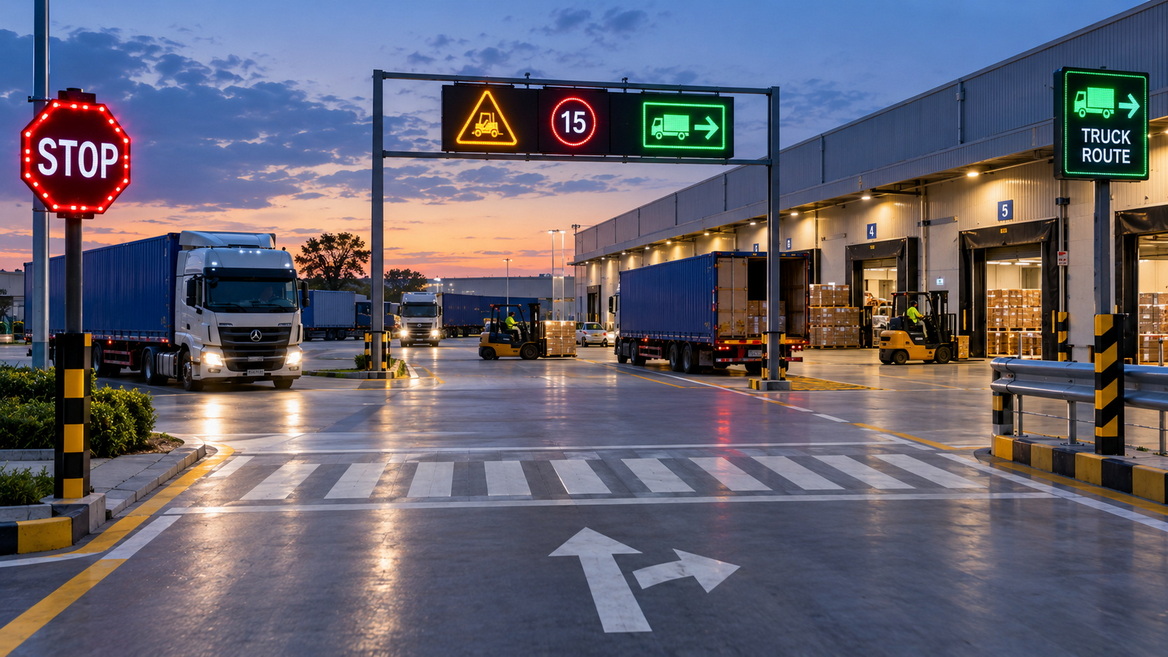
Industrial sites, ports, warehouses, factories, container yards, logistics parks, and truck terminals have unique traffic safety requirements. These environments often combine heavy trucks, forklifts, pedestrians, loading equipment, visitors, and internal vehicles on the same site.
LED traffic signs can help separate traffic flows and improve visibility around conflict points.
Common industrial applications include:
- LED STOP signs at truck intersections
- LED forklift crossing signs
- LED speed limit signs
- LED truck route signs
- LED pedestrian crossing signs
- LED loading bay signs
- LED hazardous-area warning signs
- LED one-way signs
- LED restricted-access signs
- LED emergency-route signs
- LED container-yard directional signs
- LED parking and queue-management signs
A logistics park may use LED STOP signs at crossings between truck routes and pedestrian paths. It may also use LED speed-warning signs near loading docks, LED directional signs for truck circulation, and LED warning signs near forklift activity zones.
For industrial buyers, the greatest advantage is often customization. The sign design can be adapted to site-specific hazards, local language requirements, vehicle types, road layout, and branding needs.
LED flashing signs should be installed where they address a specific risk. Installing them everywhere can reduce their impact because drivers may become accustomed to frequent flashing signals.
A structured site assessment can help determine where LED enhancement is most needed.
Start with available records. Review crash reports, insurance claims, operational incidents, near-miss reports, security footage, and driver complaints.
Look for patterns such as:
- Right-angle crashes
- Rear-end collisions
- Failure-to-stop incidents
- Wrong-way entries
- Run-off-road events
- Pedestrian conflicts
- Truck turning conflicts
- Collisions during darkness or rain
- Repeated incidents at one approach direction
Crash history is valuable, but near-miss data can be equally important. A location may have many dangerous events without recorded collisions.
Field observation can reveal problems that are not obvious in reports. Watch how drivers approach the location at different times of day and in different weather conditions.
Important behaviors to identify include:
- Late braking
- Rolling stops
- Ignoring YIELD signs
- Excessive speed
- Sudden lane changes
- Missed turns
- Wrong-way movement
- Drivers looking for signs too late
- Drivers blocking pedestrian crossings
- Commercial vehicles struggling to follow the intended route
Video monitoring, traffic counts, radar data, and on-site staff feedback can provide useful information during this stage.
A sign may not work effectively if it is hidden, too close to the decision point, placed at the wrong height, poorly illuminated, or competing with too many nearby visual elements.
Review the following conditions:
- Sight distance
- Road curvature
- Road grade
- Lane configuration
- Sign mounting height
- Sign offset from the road
- Tree branches and vegetation
- Street lighting
- Headlight glare
- Commercial signs and billboards
- Weather exposure
- Pavement-marking condition
- Driver approach speed
- Distance available for braking and decision-making
An LED traffic sign should be part of a coordinated signing and road-safety layout. It cannot correct a fundamental problem such as poor intersection geometry, inadequate sight distance, missing lane markings, or uncontrolled vehicle speed.
The correct product depends on the application, local standard, weather conditions, traffic volume, power availability, sign size, viewing distance, and operating schedule.
A parking garage may require a compact AC-powered LED sign with controlled brightness. A rural road may need a solar-powered LED warning sign with battery backup. A toll station may require synchronized LED lane-control signs capable of operating for long periods.
| Specification Area | Key Questions to Ask |
|---|---|
| Sign face | What message, symbol, color, language, and size are required? |
| Sign material | Is the aluminum substrate corrosion resistant and suitable for outdoor use? |
| Reflective sheeting | What grade of reflective film is used, and what is its expected outdoor durability? |
| LED layout | Are LEDs installed on the border, symbol, legend, or a combination of these areas? |
| LED brightness | Is the brightness visible at the required viewing distance without causing glare? |
| Flashing mode | Will the LEDs flash simultaneously, continuously, or according to a timed program? |
| Power supply | Is the sign powered by AC, DC, solar energy, or a battery system? |
| Solar system | Is the solar panel and battery capacity suitable for local weather and operating hours? |
| Weather protection | Can the sign withstand rain, dust, humidity, UV exposure, heat, and vibration? |
| Installation method | Is the sign designed for pole, wall, gantry, portable base, or existing post installation? |
| Control options | Does the project require timers, photocells, remote control, sensors, or wireless synchronization? |
| Maintenance | Are LED modules, batteries, controllers, and wiring easy to inspect and replace? |
| Customization | Can the supplier provide OEM branding, private-label packaging, special dimensions, or multilingual graphics? |
Solar-powered LED traffic signs are suitable for locations where grid electricity is unavailable, difficult to install, or expensive to maintain.
They are commonly used on rural roads, highway approaches, construction zones, parking areas, industrial sites, temporary projects, and remote intersections.
A solar LED sign system typically includes:
- LED traffic sign face
- Solar panel
- Rechargeable battery
- Solar charge controller
- Weatherproof enclosure
- Programmable flashing controller
- Mounting brackets or support pole
Solar systems should be designed based on local sunshine conditions, expected operating hours, battery autonomy, LED power consumption, panel angle, shading risk, and seasonal weather variation.
AC-powered LED traffic signs are often suitable for toll plazas, urban streets, parking facilities, commercial areas, factories, and locations with existing electrical infrastructure.
They can support continuous or extended operating schedules without depending on daily solar charging. AC-powered signs may also be easier to integrate with central controls, sensors, security systems, parking management systems, or other site infrastructure.
Low-voltage DC LED signs can be used in controlled environments such as warehouses, private roads, underground parking garages, factories, ports, and logistics centers. These systems may be integrated with existing low-voltage infrastructure or safety control systems.
An LED traffic sign is a long-term safety asset. Its performance depends on regular inspection and preventive maintenance.
A maintenance plan should include:
- Cleaning the sign face and solar panel
- Checking LED flashing operation
- Inspecting cables and electrical connectors
- Reviewing battery condition and charging performance
- Checking brackets, bolts, and pole stability
- Inspecting weather seals and enclosures
- Confirming that the sign face remains visible and readable
- Removing vegetation or obstructions
- Testing timers, photocells, sensors, and remote-control functions
- Replacing damaged LED modules or reflective sheeting when needed
Retroreflective sheeting remains important even on an LED enhanced sign. If the LED system is turned off, temporarily unavailable, or affected by a power issue, the basic traffic sign still needs to provide a clear and recognizable message.
For this reason, product quality should be evaluated as a complete system rather than only by the number of LEDs installed.
Shenzhen Xingsheng Traffic Facilities Co., Ltd. provides customized LED traffic signs and traffic safety solutions for public roads, highways, toll stations, parking facilities, commercial developments, logistics parks, factories, and industrial projects.
We can support customized requirements for:
- LED flashing STOP signs
- LED YIELD signs
- LED pedestrian crossing signs
- LED school zone signs
- LED curve warning signs
- LED chevron signs
- LED speed signs
- LED toll plaza signs
- LED parking guidance signs
- LED truck route signs
- LED industrial warning signs
- Solar-powered LED traffic signs
- AC-powered LED traffic signs
- OEM branding and private-label packaging
- ODM sign designs for specific traffic applications
- Customized symbols, languages, dimensions, and flashing patterns
- Export-oriented packaging and project documentation
Our manufacturing team can help customers develop LED traffic sign solutions based on their target market, project drawings, installation environment, voltage requirements, power source, traffic scenario, and branding needs.
LED embedded flashing signs are most effective when used at locations where drivers need stronger visual guidance. Unsignalized intersections, sharp curves, pedestrian crossings, toll plazas, parking facilities, industrial roads, and logistics sites are all common applications.
The best results come from identifying the actual safety problem before selecting the product. A flashing LED sign can improve attention and support safer decisions, but it should work together with correct sign placement, suitable road markings, reliable lighting, good site design, and ongoing maintenance.
For projects requiring customized LED traffic signs, solar warning signs, flashing STOP signs, parking safety signs, toll station signs, or industrial traffic control products, Shenzhen Xingsheng Traffic Facilities Co., Ltd. can provide OEM and ODM manufacturing support tailored to your application and target market.
An LED embedded flashing traffic sign is a standard traffic sign enhanced with LED lights around its border, symbol, text, or warning area. The flashing LEDs make the sign easier for drivers to notice, particularly at night or in locations with limited visibility.
LED flashing STOP signs are most effective at unsignalized intersections with high approach speeds, poor sight distance, repeated stop-sign violations, nighttime crash concerns, frequent rolling stops, or unexpected traffic patterns.
Yes. Solar-powered LED traffic signs are widely used in rural roads, highways, construction zones, parking areas, private facilities, industrial sites, and remote intersections where electrical power is not readily available.
Yes. LED traffic signs are useful in parking garages because they can improve visibility at blind corners, ramps, pedestrian crossings, height-restricted areas, entrances, exits, and one-way lanes. Brightness should be properly selected to avoid glare in enclosed spaces.
Yes. LED traffic signs can be customized in terms of sign size, shape, language, symbol, LED layout, reflective sheeting, flashing pattern, power system, solar panel, bracket type, packaging, and OEM branding.
1. Carmanah. "Where and When LED Flashing Signs Work Best."
[https://carmanah.com/resources/where-and-when-led-embedded-flashing-signs-work-best/]
2. Federal Highway Administration. "Safety Evaluation of Flashing Beacons at Stop-Controlled Intersections."
[https://www.fhwa.dot.gov/publications/research/safety/08048/index.cfm]
3. Minnesota Department of Transportation. "Impact of Flashing LED Stop Signs on Crash Reduction and Driver Behavior."
[https://mdl.mndot.gov/_flysystem/fedora/2023-02/201402ts.pdf]
4. Federal Highway Administration Crash Modification Factors Clearinghouse. "Crash Reduction Effects of Flashing LED Stop Signs."
[https://cmfclearinghouse.fhwa.dot.gov/study_detail.php?stid=265]
5. Federal Highway Administration. "Roadway Departure Safety."
[https://highways.dot.gov/safety/RwD]
6. Federal Highway Administration. "Horizontal Curve Safety."
[https://highways.dot.gov/safety/rwd/keep-vehicles-road/horizontal-curve-safety]
7. Federal Highway Administration. "Methods for Maintaining Traffic Sign Retroreflectivity."
[https://highways.dot.gov/safety/other/visibility/methods-maintaining-traffic-sign-retroreflectivity]
8. Federal Highway Administration. "Manual on Uniform Traffic Control Devices."


