
Please Choose Your Language
Views: 244 Author: XS Traffic Facilities Publish Time: 2026-07-03 Origin: Site


Content Menu
● What Is a Solar Warning Light System?
● Core Components and How Solar Warning Lights Work
● Types of Solar Warning Lights for Traffic and Parking Safety
>> Low‑Intensity (Type A) Solar Warning Lights
>> High‑Intensity (Type B) Solar Warning Lights
>> Specialized Solar Safety Lights
● Benefits of Solar Warning Lights for Roads and Parking Lots
>> Easy Installation and Flexible Deployment
>> Low Operating and Maintenance Costs
>> Strong Outdoor Adaptability
>> Green Energy and Sustainability
● Real‑World Applications: From Highways to Parking Lots
>> Road Construction and Traffic Management
>> Parking Lot and Facility Safety
>> Maritime, Aviation, and Critical Situations
● Standards, Regulations, and IP Ratings You Should Know
>> Electrical and Photometric Standards
>> IP Ratings and Environmental Protection
● How to Choose the Right Solar Warning Lights (Buyer's Mini‑Guide)
>> Priority Technical Criteria
>> Practical User‑Oriented Checklist
● Market Trends and Future Innovations in Solar Traffic Warning Lights
>> Technology and Smart Features
● OEM/ODM Solar Traffic Solutions from Shenzhen Xingsheng Traffic Facilities
>> Application‑Driven Design Philosophy
● Practical Installation and Maintenance Tips
>> Installation Best Practices
● Call to Action: Plan Your Next Solar Traffic Safety Project
● FAQs About Solar Warning Lights
>> Q1: How do solar warning lights work when there is little or no sun?
>> Q2: Are solar warning lights suitable for large multi‑level parking garages?
>> Q3: What IP rating should I choose for coastal or heavily rainy regions?
>> Q4: How long can a quality solar warning light system last?
>> Q5: What are the biggest advantages over traditional wired warning lights?
Solar warning lights are transforming road and parking lot safety by combining renewable energy, high visibility, and low maintenance—and when they're designed and manufactured by specialized OEM/ODM suppliers, they become a powerful, scalable solution for highways, toll stations, construction zones, and parking facilities worldwide.

In this in‑depth expert guide, I'll walk through:
- What solar warning lights are and how they work
- Key types and applications in traffic and parking environments
- Practical selection and maintenance tips from field experience
- Latest market and technology trends you should care about
- How a professional OEM/ODM partner like Shenzhen Xingsheng Traffic Facilities Co., Ltd. supports safer streets and smarter parking operations
Throughout, I write from a traffic safety practitioner and manufacturer's perspective, drawing on real industry use cases and up‑to‑date data.
A solar warning light is a self‑powered safety device that uses solar energy to alert, guide, or warn people and vehicles in potentially hazardous areas. Unlike traditional grid‑powered beacons, these lights rely on built‑in solar panels, batteries, and LED light sources—so they keep working even in remote locations or during power outages.
In traffic and parking environments, solar warning lights are widely used on:
- Urban streets and rural highways
- Toll stations and tunnel entrances
- Construction zones and work areas
- Parking lots, loading bays, and pedestrian crossings
Because they operate automatically from dusk to dawn, they provide continuous visual guidance with minimal human intervention.
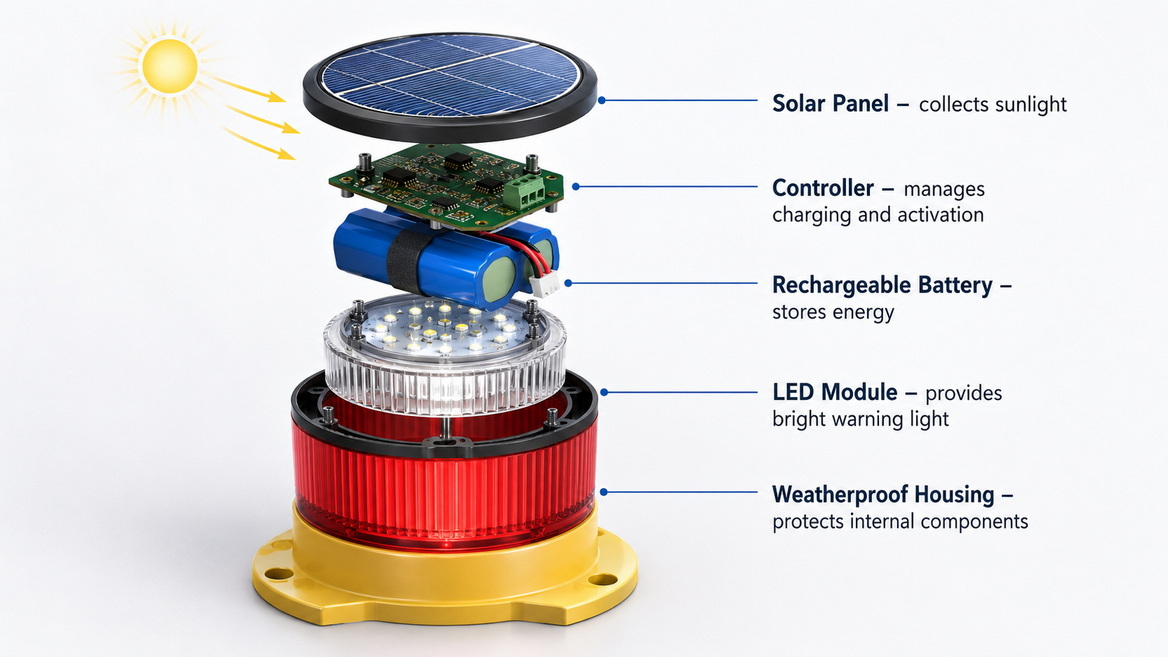
From a manufacturer's standpoint, every reliable solar warning light is built around three core components and a simple but robust working process.
- Solar Panel – Converts sunlight into electrical energy and charges the battery during daytime. - Rechargeable Battery – Stores energy for night operation and cloudy days; common chemistries include lithium ternary, lithium iron phosphate, and nickel‑metal hydride, each with different safety and cost profiles. - LED Light Source – Uses high‑intensity LEDs to produce bright, focused light in red, amber, blue, or white, depending on the application. - Intelligent Controller & Sensor – Manages charging, over‑discharging, and automatic on/off via light sensors or photocells.
1. Light Collection
During the day, solar panels built with crystalline materials capture sunlight and convert it to DC electricity. For optimal performance, panels must be kept relatively clean to maintain high conversion efficiency.
2. Energy Storage
The controller regulates charging and stores energy into the battery, protecting against overcharge and deep discharge to extend battery life. Battery capacity directly affects how many hours the light can operate at night and in low‑sun seasons.
3. Automatic Light Activation
As ambient light drops at dusk, a sensor signals the controller to power the LEDs, which then flash or remain steady according to pre‑set patterns. Typical designs use slow or burst flashing to maximize visibility while minimizing energy consumption.
This closed‑loop system allows solar warning lights to run reliably for years with only basic maintenance.
Different road and parking scenarios demand different light intensities, installation methods, and signal patterns. As both an industry observer and OEM manufacturer, I typically classify solar warning lights into several practical categories.
Low‑intensity solar warning lights are used to mark lower obstacles and localized hazards.
Common examples include:
- Flashing Solar Hazard Lights
– Mounted on cones, barricades, or small structures at roadwork zones, pedestrian diversions, and animal‑crossing areas.
Solar Barricade Lights
– Provide steady illumination on barriers, safety blocks, and temporary fencing to warn drivers and pedestrians of restricted access.
These products are ideal for short‑range visual warnings and are widely deployed in construction sites, parking lot entrances, and temporary detour routes.
High‑intensity lights are designed for situations that need strong long‑distance visibility, such as high‑speed roads and aviation facilities.
Typical use case products:
- Solar Traffic Warning Lights
– High‑brightness beacons and signal heads that help control vehicle flow at intersections, toll booths, sharp curves, and highway merges.
- Vehicle‑Mounted Solar Warning Lights
– Installed on trucks, service vehicles, patrol cars, and emergency responders for mobile hazard indication.
For parking and logistics facilities, high‑intensity lights are frequently used to mark dangerous loading zones, blind spots, and high‑traffic ramps, giving drivers more time to react.
Beyond the standard low/high‑intensity division, modern traffic safety systems increasingly deploy specialized solar devices:
- Solar Road Stud Lights
– Embedded in road surfaces or parking lanes to outline paths, slow lanes, and pedestrian routes.
- Solar Strobe Lights
– High‑intensity flashing lights used in noisy environments where audible alarms are less effective, such as warehouses and logistics docks.
- Solar Marine and Aviation Lights
– Used on buoys, docks, airport perimeters, and towers for navigation and obstacle marking.
From a parking lot safety perspective, solar road studs and compact beacon lights often deliver the highest ROI because they combine low power consumption with strong visual impact.
Solar warning lights have moved from "nice to have" to standard practice in many modern traffic projects because they solve several persistent safety and operational problems at once.
Since solar warning lights do not require grid wiring, they can be installed using simple wall mounts, brackets, poles, or magnetic bases in only a few minutes. This is especially valuable at:
- Newly built or temporary parking lots
- Remote toll gates or rural junctions
- Construction sites where electrical infrastructure is incomplete
Minimal installation complexity reduces project timelines and labor costs, while making repositioning straightforward as traffic patterns evolve.
The combination of long‑life LEDs and durable batteries means that solar warning lights typically run for years with very modest maintenance. In many field deployments, yearly maintenance budgets can stay well below conventional wired systems, mainly covering panel cleaning and periodic battery checks.
Because they draw power from the sun, they also eliminate electricity bills, which is critical for large parking facilities and long highway segments.
Well‑designed solar warning lights are engineered to withstand:
- Temperature ranges roughly from −40°C to +80°C
- Dust, rain, and wind exposure
- Corrosion risks in coastal and industrial environments
Manufacturers achieve this by using IP65–IP68 enclosures, heat‑dissipation structures for desert climates, and salt‑spray‑resistant coatings near the sea. For parking lots with open exposure or elevated installations, these protective measures significantly extend product life.
By relying entirely on solar energy, these devices help operators reduce carbon emissions, grid dependency, and copper wiring consumption, supporting broader ESG and sustainability goals. Governments and private operators increasingly favor solar solutions to align with low‑carbon infrastructure policies and secure incentives or rebates where available.
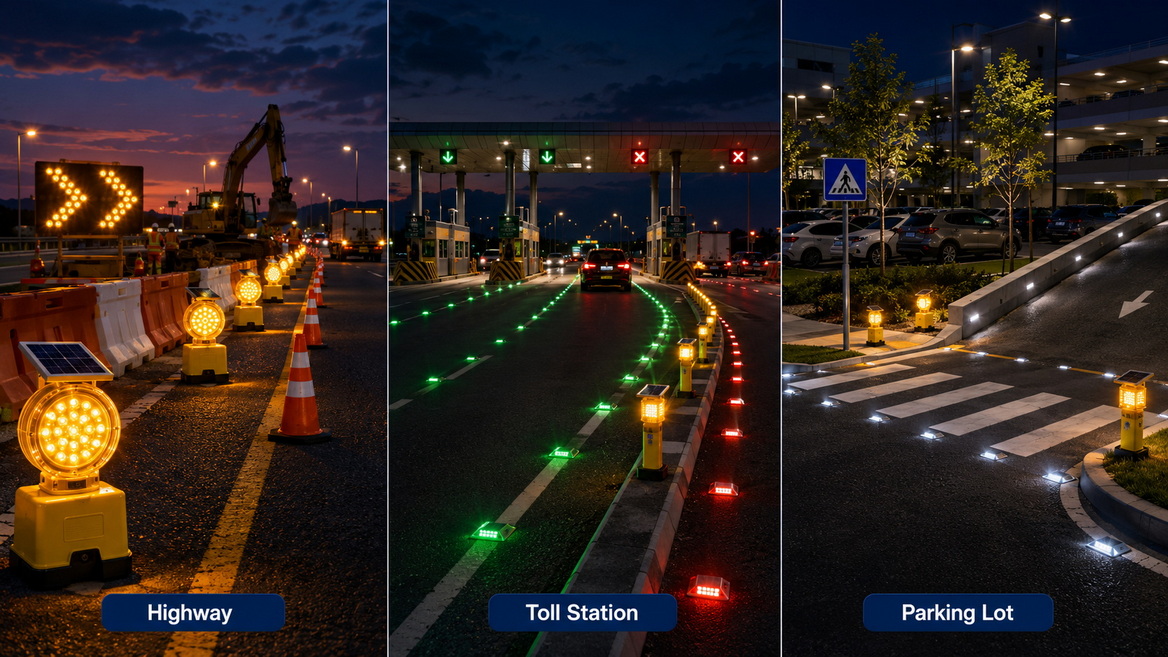
In practice, solar warning lights are integrated into complete traffic safety solutions that cover roads, toll stations, and commercial parking facilities.
On highways and city streets, solar warning lights:
- Highlight work zones, lane closures, and diversions
- Mark blind curves, steep descents, and bridge entries
- Provide temporary safety signals after accidents until full repairs are completed
By increasing visibility in transitional areas, they directly reduce rear‑end collisions and side‑swipe incidents.
For parking lots, logistics hubs, and industrial yards, solar warning lights and related devices can be used to:
- Mark entrances/exits, ramps, and pedestrian crossings
- Outline parking rows and reserved zones with solar road studs
- Warn about low‑clearance structures, tight corners, or loading docks
- Support one‑way traffic flows and speed‑control layouts
From a UX point of view, well‑placed solar lights make parking environments feel safer and more intuitive, which improves user satisfaction and reduces liability risks for facility operators.
Solar warning lights also play important roles beyond roads and parking:
- Maritime – Installed on buoys and docks to guide ships and avoid underwater or shoreline hazards.
- Aviation – Mounted on towers, wind turbines, and airfield perimeters to give pilots clearer visual references. - Emergency & Disaster Response – Used to mark dangerous zones, emergency exits, and safe assembly points when grid power fails during storms or earthquakes.
These overlapping applications underline why the technology has become a core part of modern safety systems worldwide.
As solar warning lights move from "accessories" to critical safety devices, compliance with international standards becomes non‑negotiable.
Industry organizations such as the International Electrotechnical Commission (IEC) and local traffic authorities define requirements for solar lighting systems. For example:
- IEC 62446‑1 sets guidelines for system documentation and testing of PV installations.
- IEC TC 34 covers lamps and related equipment, ensuring that LED and emergency lights meet specific performance criteria.
Project owners and OEM suppliers must align product designs with these standards and secure appropriate certifications before large‑scale deployment.
Ingress Protection (IP) codes indicate resistance to dust and water. For outdoor traffic applications, IP65 is often considered the minimum, meaning dust‑tight designs that can withstand water jets. Higher IP ratings or additional sealing are recommended for:
- Coastal parking facilities
- Mountain highways exposed to snow and meltwater
- Industrial yards with heavy dust or aggressive chemicals
Proper IP selection ensures that solar warning lights remain functional and safe even in demanding environments.
From both an engineer and SEO strategist's standpoint, the most actionable content we can provide is clear selection criteria that help traffic planners and facility managers avoid common mistakes.
When selecting solar warning lights for roads or parking lots, focus on:
- Brightness and Visibility – Ensure luminous intensity is sufficient for daylight and long‑distance visibility; under‑powered lights can create a false sense of security. - Battery Capacity and Runtime – Evaluate whether the battery supports all‑night operation under typical local sunlight conditions. - Durability and Weather Resistance – Confirm materials, IP ratings, and corrosion‑proof coatings match your climate and environment. - Flashing Modes and Control Options – Choose patterns (steady, flashing, strobe) and optional remote or sensor controls that match your safety strategy.
Before issuing a purchase order, we recommend buyers ask:
1. Is the installation method compatible with existing poles, barriers, or pavement?
2. Does the supplier provide clear maintenance instructions and spare‑part support?
3. Are there local references or case studies demonstrating performance in similar projects?
4. What warranty terms and after‑sales service options are available?
Many end users report that projects go smoother when they work with manufacturers who can offer customized flashing patterns, lens colors, and mounting hardware for their specific site layout.
The solar traffic warning light market has been growing steadily, driven by infrastructure expansion, stricter safety regulations, and renewable‑energy adoption.
Recent industry analyses estimate the global solar traffic warning light market at roughly USD 250 million in 2025, with a projected compound annual growth rate around 7% up to 2033. For solar traffic lights more broadly, some reports forecast the market size rising from approximately USD 1.2 billion in 2024 to significantly higher levels by 2033, supported by smart‑city and highway investments.
Highway and railway segments currently lead adoption, followed by car parks and tunnels, where operators seek cost‑effective, low‑maintenance safety solutions.
Emerging trends include:
- Higher‑efficiency solar panels and batteries, extending runtime and reducing product size.
- Intelligent controllers with IoT connectivity, enabling remote monitoring of status, battery health, and failure alerts.
- Adaptive flashing patterns that can respond to traffic volume, weather conditions, or emergency signals.
Manufacturers that integrate these features into solar warning lights and parking lot safety devices will be better positioned to serve future smart‑transport projects.

As a China‑based manufacturer focused on solar traffic lights, parking lot safety facilities, and integrated traffic solutions, Shenzhen Xingsheng Traffic Facilities Co., Ltd. can support projects from concept design to mass production.
For international buyers and project contractors, working with an OEM/ODM partner brings:
- Customized designs – Tailored lens colors, housing materials, mounting systems, and control logic to match local standards and project branding.
- System‑level integration – Coordinated solutions that combine solar traffic lights, warning beacons, road studs, bollards, and parking guidance elements into one safety strategy.
- Export expertise – Experience with packaging, certification, and logistics for global markets.
Shenzhen‑based manufacturers also benefit from strong supply chains for LEDs, batteries, and solar components, allowing competitive pricing and stable delivery.
From an industry expert perspective, the most effective OEM projects start with on‑site risk analysis:
- Assess traffic flows, peak periods, weather patterns, and driver behavior
- Map accident history and near‑miss zones
- Design a layered system using different solar warning light types for high‑risk versus low‑risk segments
By treating solar warning lights as part of a holistic traffic and parking safety ecosystem, we can significantly reduce incident rates while maintaining attractive lifecycle costs.
Even the best‑designed solar warning lights require simple but consistent care to perform optimally in the field.
- Position panels to maximize sun exposure and avoid shading from buildings, trees, or signboards. - Use appropriate mounting hardware and anti‑theft fasteners, especially in public parking areas.
- Set flashing patterns and orientations to avoid glare while maximizing driver awareness.
End users commonly ask whether solar warning lights are truly "maintenance‑free". In practice, we advise:
- Periodic panel cleaning to remove dust, bird droppings, and pollution film. - Visual inspections for cracks, water ingress, or signs of corrosion.
- Battery checks every few years, with replacement at the end of service life.
Following these simple routines greatly reduces unexpected failures and keeps safety performance consistently high.
If you are planning to upgrade street, highway, toll station, or parking lot safety, now is the right time to evaluate solar warning light solutions backed by professional manufacturing support.
Leverage the expertise of an OEM/ODM partner like Shenzhen Xingsheng Traffic Facilities Co., Ltd. to:
- Design a site‑specific solar traffic safety方案
- Choose the right mix of solar traffic lights, warning beacons, and parking lot safety facilities
- Secure durable, compliant products that deliver long‑term value
You can reach our team to discuss technical requirements, customization options, and sample projects tailored to your market.
A1: Solar panels charge the battery during peak sunlight hours; stored energy then powers the LEDs at night or in cloudy conditions, provided the system is properly sized for local irradiance.
A2: Yes, but panel placement and exposure must be planned carefully; rooftop or external mounting with cabling to interior fixtures is often used in multi‑storey environments.
A3: At least IP65 is recommended, with higher IP ratings or additional sealing and anti‑corrosion coatings for coastal roads and open parking facilities.
A4: With proper design and regular basic maintenance, LEDs can often exceed 50,000 hours, and batteries typically deliver several years of service before replacement is needed.
A5: Reduced installation complexity, no grid connection, lower operating costs, strong adaptability in remote or temporary sites, and alignment with sustainability and low‑carbon development goals.
1. Jackwin Safety. "What is a Solar Warning Light? Working, Types, Benefits, and Uses."
https://jackwinsafety.com/solar-warning-light-working-types-benefits-uses/
2. RoadSky Safety. "What is a Solar Warning Light?"
https://roadskysafety.com/what-is-a-solar-warning-light
3. Luxman Light. "Benefits and Uses of Solar Powered LED Traffic & Solar Warning Light."
https://luxmanlight.com/benefits-and-uses-of-solar-powered-led-traffic-solar-warning-light/
4. Lightway Traffic. "How to Choose Solar Warning Lights | Ultimate Buying Guide 2026."
https://www.lightwaytraffic.com/solar-warning-light-choosing-guide/
5. Archive Market Research. "Solar Energy Traffic Warning Lights Decade Long Trends, Analysis and Forecast 2025‑2033."
https://www.archivemarketresearch.com/reports/solar-energy-traffic-warning-lights-222884
6. LinkedIn. "Solar Traffic Light Market – Trends, Innovations & Strategic Insights."
https://www.linkedin.com/pulse/solar-traffic-light-market-trends-innovations-strategic-h5wif
7. Nokin Street Light. "The Future of Solar Street Lights: Trends and Innovations You Need to Know."
https://www.nokinstreetlight.com/blog/company/the-future-of-solar-street-lights.html
8. Ruichen / Industry Article. "The Future of Solar Traffic Signs in 2026: Smarter, More Durable, and Built for Road Safety."
9. XS Traffic Facilities Company Profile (Shenzhen‑based).


