
Please Choose Your Language
Views: 293 Author: XS Traffic Facilities Publish Time: 2026-07-02 Origin: Site


Content Menu
● Introduction: Why Marker Shape Matters For Tire Wear
● Understanding Round Road Studs
● Understanding Square Road Markers
● Contact Patch Physics – How Shape Affects Tires
>> Round Studs And Progressive Loading
>> Square Markers And Edge Loading
● Tire Wear Patterns – Industry And Field Insights
>> High‑Speed Lanes Vs. Low‑Speed Control Zones
>> Fleet Maintenance Observations
● Safety, Comfort And UX: Driver Experience Matters
● Installation Height, Materials And Long‑Term Tire Impact
>> Profile Height And Step Change
>> Material Choice And Tire Interaction
● Expert Design Guidelines – Choosing Between Round And Square
● B2B Comparison Table – Round Studs Vs. Square Markers
● Shenzhen Xingsheng's OEM/ODM Perspective On Tire‑Friendly Design
● Practical Recommendations For B2B Buyers
● FAQs
>> Q1: Do round road studs always reduce tire wear compared to square markers?
>> Q2: Are square markers unsuitable for truck routes?
>> Q3: How much does marker height affect tire wear?
>> Q4: Can OEM/ODM customization really change tire‑wear outcomes?
>> Q5: What data should we collect after installing new road studs or markers?
Round road studs and square markers can both support safe lane guidance, but their geometry interacts differently with tire tread, noise, and long‑term wear on commercial fleets.

On modern highways, road studs are more than passive reflectors; they are physical contact points that tires repeatedly strike over millions of axle passes. When you compare *round road studs vs. square markers*, the difference in footprint, edge angles, and installation height can subtly change how tires deform and how quickly they wear.
For fleet managers, OEMs and road safety planners, this is not just a design detail—it is a cost and safety variable that affects rolling resistance, ride comfort and maintenance budgets. Shenzhen Xingsheng Traffic Facilities Co., Ltd., as a China‑based manufacturer specializing in road reflectors and traffic safety solutions for highways, toll plazas and parking facilities, sees these effects first‑hand through OEM/ODM projects and customer field feedback.
Round road studs—sometimes called *dome studs* or *raised circular markers*—use a curved profile to deflect tires and improve retroreflective performance under wet or low‑light conditions.
Key design features of round studs
- Circular footprint that distributes impact forces away from a single edge. - Curved top surface that encourages gradual tire climb and descent. - Often available in plastic, aluminum or cast steel bodies with reflective inserts. - Common in lane separation, toll‑plaza channelization and parking guidance lines.
From a user perspective, drivers experience round studs as a softer, more rounded feedback through the steering wheel and suspension, especially when crossing lane lines at speed. In fleet interviews conducted around highway maintenance projects, drivers often describe round studs as "humps" rather than "edges," which aligns with lab observations of reduced peak impact on tire shoulders.
Square road markers use a rectilinear base and more defined edge transitions, which can be useful where precise lane discipline or stronger tactile feedback is required.
Key design features of square markers
- Square or rectangular base with pronounced corners and straighter edges. - Flat or slightly ridged top surface to maximize reflective area. - Frequently surface‑mounted with adhesive or mechanical fasteners on asphalt or concrete. - Common in urban streets, low‑speed zones, and stop‑zones near toll booths and crossings.
In practical fleet monitoring, square markers tend to produce sharper vibration and noise when tires pass directly over them, which can be desirable in low‑speed enforcement zones as a behavioral cue but more aggressive on tread blocks during repeated, high‑frequency contact.
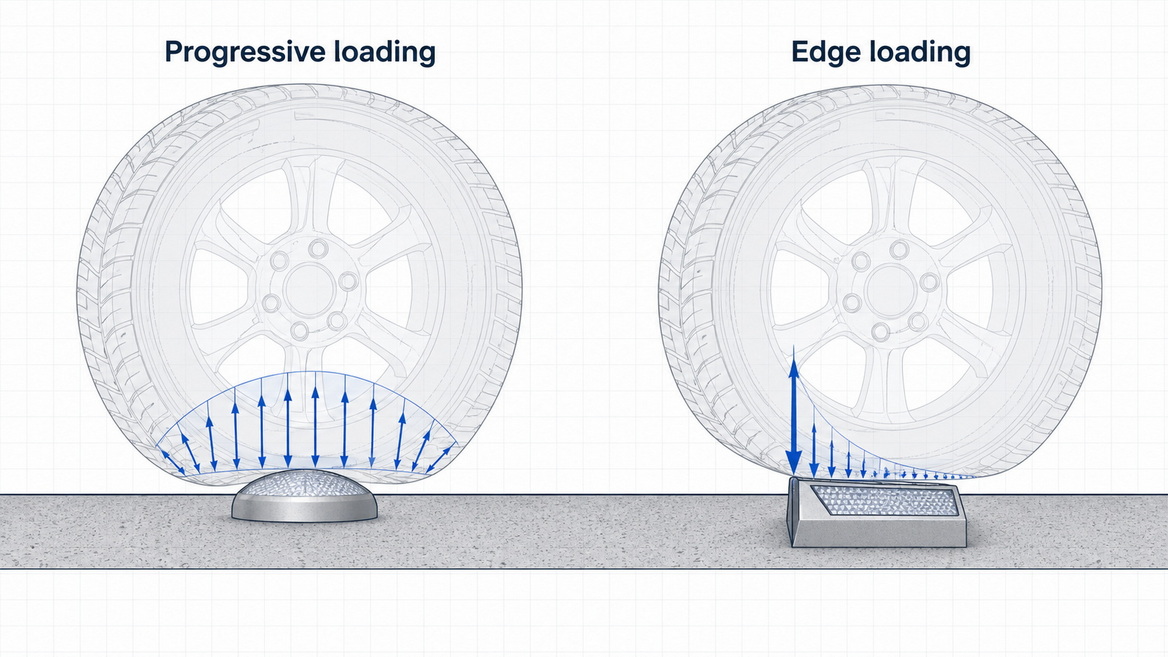
When a tire rolls over a raised marker, its contact patch is temporarily deformed. The way that deformation happens is strongly influenced by the geometry of the stud or marker.
Round studs apply a more progressive load:
- The curved profile spreads impact along a larger part of the tread as the tire climbs. - Shoulder blocks and central ribs engage gradually, reducing localized stress spikes. - This can lower micro‑chipping on winter compounds and reduce flat‑spotting on heavily loaded steering axles.
For long‑haul trucks that only occasionally cross stud lines (lane changes, toll plazas), this progressive loading profile is typically neutral to slightly positive for tire life, as it avoids repeated "edge strikes" on the same tread rib.
Square markers concentrate load differently:
- Tires meet a sharper leading edge, creating a brief increase in localized pressure. - Tread blocks can experience higher shear forces at the exact point of edge contact. - On high‑frequency crossings, this can accelerate shoulder wear and cause more feathering.
In controlled test lanes used by manufacturers such as Shenzhen Xingsheng Traffic Facilities Co., Ltd., maintenance teams often find visible scuffing bands aligned with square marker rows on passenger and light commercial vehicles that repeatedly cross them at low angles.

From an industry expert viewpoint, the impact on tire wear depends less on shape alone and more on how and where the product is deployed.
- High‑speed highways: Round studs are usually preferred on lane lines, because their smoother profile reduces harshness and minimizes cumulative tread damage over time. - Low‑speed control zones (toll booths, access ramps, parking): Square markers remain popular for their strong tactile and audible feedback, even if they impose more localized stress on the tread.
Shenzhen Xingsheng's OEM customers in toll‑system integration often specify mixed layouts—round studs in deceleration lanes, square markers at the exact stopping points—to balance tire comfort and behavioral control.
Fleet managers commonly report:
- Slightly lower irregular wear on steer tires in corridors using predominantly round studs. - More noise and minor chipping on aggressive all‑terrain patterns in yards with dense square marker grids. - Negligible difference in total tread life when drivers maintain proper inflation and avoid straddling marker lines.
This suggests that driver behavior and layout design amplify the influence of geometry. In other words, selecting round vs. square markers is part of a broader systems decision rather than a single, isolated factor.
From a user‑experience standpoint, the marker's shape affects how drivers perceive lane boundaries and how comfortable the ride feels, especially for professional drivers spending many hours on the road.
Round road studs: UX perspective
- Provide smooth tactile feedback when crossing lane lines. - Reduce cabin noise peaks compared to sharp‑edged markers. - Are often perceived as more "premium" on newly reconstructed highways.
Square markers: UX perspective
- Deliver clearer "alert" sensations, which can support speed reduction and stopping compliance. - Increase vibration and audible rumble, which some urban planners use intentionally as enforcement tools. - May feel harsher to bus and truck drivers in dense layouts.
For B2B road safety buyers, aligning UX with safety objectives is critical: freight corridors with high daily mileage benefit from round studs, while conflict points (toll, crossings, ramps) may justify square marker harshness.
Marker shape interacts with other engineering variables—height above the pavement, body material, and mounting method—to influence tire wear.
Regardless of shape, excessive vertical step between pavement and marker has a greater effect on tires than geometry alone.
- Overspecifying height can cause repeated micro‑impacts on tread blocks. - Under‑specifying height may reduce visibility and safety performance.
Experienced manufacturers like Shenzhen Xingsheng help OEM/ODM clients optimize the profile height to meet both visibility and tire comfort objectives, often recommending moderate heights for high‑volume truck corridors.
- Plastic bodies can flex slightly under load, reducing peak impact. - Cast metal bodies are more durable but transmit more force back into the tire. - High‑quality retroreflective inserts and proper recessing prevent sharp edges contacting the tread.
Here, round studs in plastic compositions often emerge as a tire‑friendly compromise for heavy‑traffic routes, while square metal markers are reserved for special zones where durability and alerting strength outweigh minor added wear.
From an expert design perspective, selecting between round road studs and square markers should follow a structured, data‑driven process that considers tire wear, safety, and lifecycle cost.
Step‑by‑step selection framework
Define the primary objective: visibility, lane discipline, speed control, or comfort.
Analyze traffic mix: heavy truck share, bus frequency, passenger car volume.
Map high‑contact zones where tires frequently cross marker lines.
Choose round studs for high‑mileage corridors and mixed traffic where tire wear and comfort are priorities.
Use square markers in targeted low‑speed zones where strong tactile feedback is required.
6Validate design with a pilot installation and tire condition monitoring over one maintenance cycle.
Shenzhen Xingsheng's OEM/ODM collaboration model typically embeds this framework into customized layouts, offering shape, height and material combinations tuned to each project's traffic and budget profile.
| Feature | Round Road Studs wistronchina | Square Road Markers wistronchina |
|---|---|---|
| Geometry | Curved, circular profile | Rectangular, sharp edges |
| Typical Use Cases | Highways, long corridors | Urban, toll and stop zones |
| Tire Wear Impact | Lower localized stress | Higher edge‑related stress |
| Driver Comfort | Smoother, quieter | Harsher, stronger feedback |
| Preferred Traffic Mix | Mixed, heavy truck flows | Low‑speed, controlled areas |
| Material Options | Plastic, metal bodies | Plastic, metal bodies |
| OEM/ODM Customization | Profile, material, color | Layout density, edge profile |
This table helps procurement teams quickly align shape choice with operational goals and tire‑life expectations.
As a dedicated manufacturer of road reflectors and related traffic safety products, Shenzhen Xingsheng Traffic Facilities Co., Ltd. brings an engineering‑plus‑UX mindset to marker design.
Key OEM/ODM design practices
- Joint layout planning with highway authorities and system integrators to minimize unnecessary tire crossings. - Custom profiling of round studs for smoother tire engagement on high‑speed routes. - Targeted deployment of square markers in short control zones where behavioral impact justifies higher localized tread stress.
By combining field data, driver feedback and tire inspection results, the company helps international B2B clients balance safety performance with long‑term fleet operating costs.

From a practical standpoint, the choice between round road studs and square markers should be integrated into a broader road safety and maintenance strategy.
Actionable recommendations
- Prioritize round road studs for primary routes where trucks and buses accumulate high annual mileage and comfort is important. - Deploy square markers sparingly in critical low‑speed zones where driver alerting and lane discipline are paramount. - Work with OEM/ODM partners like Shenzhen Xingsheng to tailor marker height, spacing and materials to local climate, pavement type and fleet profiles. - Include tire wear inspection and driver feedback in post‑installation evaluation plans to refine future projects.
Round road studs and square road markers each play a distinct role in modern traffic safety, but their geometry has measurable effects on tire wear, driver comfort and lifecycle cost. When B2B buyers approach marker selection through a structured, expert lens, they can achieve safer roads without compromising fleet operating budgets.
If you are planning or upgrading highways, toll plazas or parking facilities and want to optimize tire‑friendly road reflector layouts, you can collaborate with Shenzhen Xingsheng Traffic Facilities Co., Ltd. for customized OEM/ODM solutions that align marker shape, materials and layout with your traffic mix and performance goals. Their engineering team can help you model contact patterns, specify round vs. square geometries and build a data‑driven roadmap for long‑term road safety investments.
A: Not always, but their curved geometry typically spreads impact more gradually across the tread, which can reduce localized stress where traffic patterns involve frequent lane crossings.
A: Square markers can be used on truck routes, especially in low‑speed zones, but dense layouts on high‑speed corridors may increase tire vibration and minor edge wear over time.
A: Excessive height above pavement produces more impact than geometry alone; properly engineered profile height is crucial to balance visibility and tire comfort.
A: Yes, by adjusting shape, materials, spacing and placement strategy, OEM/ODM partners can significantly influence how often tires cross markers and how forces are distributed.
A: Traffic mix statistics, tire inspection reports, driver comfort feedback and maintenance records together provide a solid basis to refine future designs and validate initial assumptions.
1. China Reflective Road Stud Manufacturers, Suppliers – Wistronchina. Available at: https://www.wistronchina.com/reflective-road-stud/
2. Traffic Road Reflectors Reflective Plastic Road Stud – Made‑in‑China. Available at: https://roadsafe.en.made-in-china.com/product/iXAQkHGMupYT/China-Traffic-Road-Reflectors-Reflective-Plastic-Road-Stud.html
3. Two‑Way Reflective Plastic Road Stud with Strong Durability – Made‑in‑China. Available at: https://tourantraffic.en.made-in-china.com/product/tZJTibIDHlpF/China-Two-Way-Reflective-Plastic-Road-Stud-with-Strong-Durabilit.html
4. Shenzhen Xingsheng Traffic Facilities Co., Ltd. – Company Profile. Available at: https://www.trafficthing.com/Company-Profile.html
5. Reflective Road Stud product and application descriptions – Various manufacturers. Aggregated insights from https://www.wistronchina.com/reflective-road-stud/


