
Please Choose Your Language
Views: 222 Author: XS Traffic Facilities Publish Time: 2026-06-28 Origin: Site


Content Menu
● Ni-Mh Rechargeable Batteries Vs. Supercapacitors for Solar Studs (Overview)
● How Solar Studs Work in Real Road Environments
● Ni-Mh Rechargeable Batteries in Solar Studs
>> Core Characteristics of Ni-Mh in Road Markers
>> Advantages of Ni-Mh for Solar Stud Projects
>> Limitations and Lifecycle Concerns
● Supercapacitors for Solar Studs
>> What Supercapacitors Bring to Road Safety Products
>> Advantages of Supercapacitors in Solar Road Markers
>> Drawbacks and Design Trade-offs
● Direct Comparison – Ni-Mh Vs. Supercapacitors in Solar Studs
>> Key Technical and Operational Parameters
● Industry Case Insight – Transition to Supercapacitor Solar Studs
● Expert Perspective – Matching Technology to Application
>> When Ni-Mh Still Makes Sense
>> When Supercapacitors Are the Strategic Choice
● Practical Checklist – Choosing Between Ni-Mh and Supercapacitors
● OEM/ODM Opportunities with Shenzhen Xingsheng Traffic Facilities Co., Ltd.
● Call to Action – Selecting the Right Solar Stud Partner
● FAQ – Ni-Mh Batteries Vs. Supercapacitors for Solar Studs
>> 1. Are supercapacitor solar studs always better than Ni-Mh options?
>> 2. How long do supercapacitor solar studs typically last?
>> 3. Do Ni-Mh batteries perform well in hot climates?
>> 4. Can solar stud manufacturers offer both technologies in one product line?
>> 5. What should I tell procurement teams when justifying supercapacitor pricing?
Ni-MH rechargeable batteries and supercapacitors are the two dominant energy‑storage options for modern solar studs, and choosing between them directly impacts lifetime, safety performance, and total cost of ownership for road‑safety projects. This article compares both technologies from an expert B2B and manufacturer perspective, with a focus on solar road markers used on streets, highways, toll stations, and parking lots.
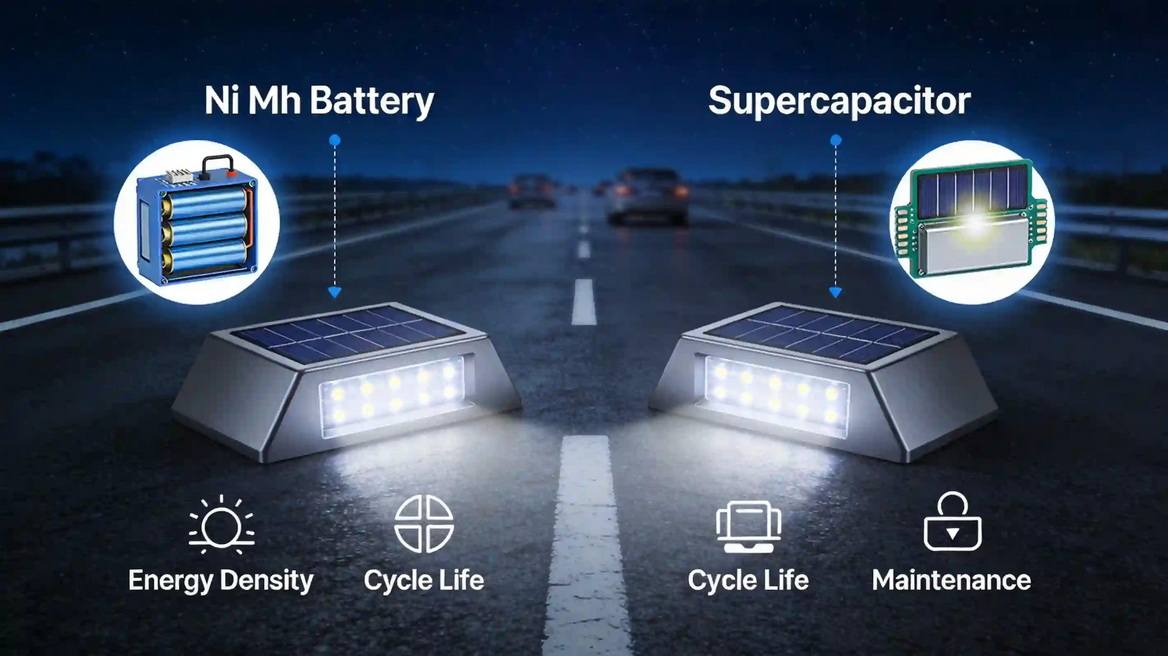
Solar studs (solar road markers) rely on a compact energy‑storage system to power LEDs through nightly duty cycles and harsh outdoor conditions. For years, Ni‑MH rechargeable batteries were the mainstream choice, but advances in supercapacitor technology have created a compelling alternative for high‑duty, maintenance‑critical installations.
From the standpoint of a Chinese OEM/ODM manufacturer like Shenzhen Xingsheng Traffic Facilities Co., Ltd., the core question is not just "which cell is better," but "which technology aligns with the project's safety requirements, climate, installation volume, and maintenance strategy."
Solar studs integrate solar panels, energy‑storage devices, control circuitry and high‑intensity LEDs into a compact housing embedded in or surface‑mounted on the road. During daytime, the panel harvests sunlight and charges either Ni‑MH cells or supercapacitors; at night, the stored energy powers flashing or constant LED modes to improve lane guidance and hazard visibility.
Typical application scenarios include:
- Urban streets and crosswalks for pedestrian safety. - Highways and expressways for lane delineation and curve warning. - Toll stations and interchanges for queue and barrier indication. - Parking lots and logistics yards for traffic routing and bay identification.
In all of these, reliability and visibility throughout the night are critical KPIs that depend directly on the performance of the energy‑storage system.
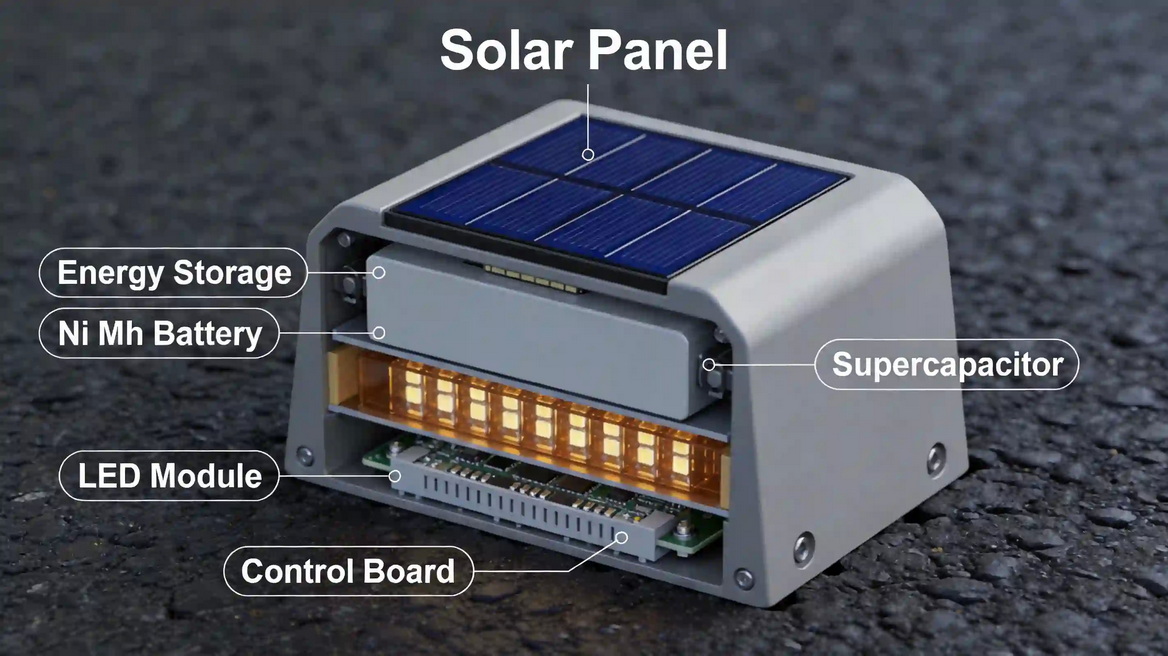
Ni‑MH (nickel‑metal hydride) batteries are a mature chemical energy‑storage technology widely used in portable electronics and lighting. In solar studs, Ni‑MH cells offer:
- Moderate energy density, enabling several nights of operation with compact cell sizes.
- A relatively stable voltage profile suitable for driving LED drivers without complex power electronics. - Established supply chains and predictable pricing from numerous Chinese and global vendors.
For OEM/ODM manufacturers, Ni‑MH remains an easily configurable option when clients request standard duty cycles and familiar bill‑of‑materials structures.
Key strengths of Ni‑MH within solar road marker applications include:
- Higher energy storage per unit volume than supercapacitors, supporting longer autonomy during consecutive cloudy days.
- Mature safety profile compared with some Li‑ion chemistries; less risk of thermal runaway when correctly engineered. - Competitive cost for mid‑scale projects and retrofit applications where installers are familiar with battery‑based solar studs.
When a highway authority needs high brightness and long night‑time endurance with a familiar maintenance model, Ni‑MH can still be the preferred option.
Ni‑MH technology also presents specific constraints in demanding road environments:
- Cycle life is limited to a few hundred to a few thousand charge–discharge cycles, after which capacity declines and batteries must be replaced. - Performance degrades under prolonged high‑temperature exposure, a common condition on asphalt surfaces in summer. - Replacement operations require lane closures, labor, and disposal of spent cells, which increases total lifecycle cost at network scale.
For municipalities managing thousands of solar studs across highways, these factors can significantly impact operational expenditure (OPEX) and service continuity.
Supercapacitors (electrochemical double‑layer capacitors) store energy via physical charge separation rather than chemical reactions, allowing extremely fast charge and discharge. In solar road studs, recent designs with larger internal space can host supercapacitor modules capable of:
- Working more than 60 hours in constant‑light mode and 110 hours in flashing mode per full charge, under optimized circuit design.
- Delivering cycle lifetimes exceeding hundreds of thousands of cycles with minimal capacity fade. - Operating reliably for up to 10 years in well‑engineered solar stud products, significantly extending maintenance intervals.
These characteristics shift the focus from short‑term component cost to long‑term system reliability—a key concern for road operators and B2B buyers.
Compared with traditional Ni‑MH batteries, supercapacitors offer several mission‑critical benefits:
- Ultra‑long cycle life: Ideal for daily charge–discharge cycles in solar studs that operate every single night.
- Fast charging: Can reach usable charge levels within short exposure windows, helping performance in shaded or high‑latitude installations. - Robustness to temperature and over‑charge events, reducing failure rates in high‑heat and high‑radiation environments.
- Lower environmental burden at end of life, as supercapacitors typically involve fewer hazardous materials than many chemical battery systems.
For large‑scale projects—such as highway networks or national road‑safety upgrades—these features can dramatically improve availability and safety performance.
However, supercapacitors are not a universal solution and require careful design:
- Lower energy density than Ni‑MH means larger physical volume or more modules to reach similar autonomy. - Component cost per Wh of stored energy is typically higher, which may affect initial CAPEX, especially for budget‑constrained local projects. - The charging and discharging profile demands appropriate control circuitry, and OEMs must tune LED drivers and duty cycles around the technology's characteristics.
A professional OEM like Shenzhen Xingsheng must therefore co‑design optics, electronics, and mechanical housings to fully leverage supercapacitor performance in solar studs.
Below is a high‑level comparison of Ni‑MH batteries vs. supercapacitors for solar studs:
| Parameter | Ni-Mh Rechargeable Batteries | Supercapacitors |
|---|---|---|
| Energy storage mechanism | Chemical reaction in electrodessciencedirect | Physical charge separation and double layersciencedirect |
| Energy density | Higher, compact capacity per volumesciencedirect | Lower, larger volume for same energysciencedirect |
| Power density | Moderatesciencedirect | Very high, instant charge/dischargesciencedirect |
| Cycle life | Hundreds to thousands of cyclessciencedirect | Hundreds of thousands of cyclesnk-roadstud+1 |
| Typical service life in solar studs | 2–5 years depending on climate and usagesciencedirect | Up to ~10 years in optimized designsnk-roadstud |
| Charging speed | Hours for full chargesciencedirect | Seconds to minutes for usable chargesciencedirect |
| Temperature robustness | Sensitive to high heat, capacity fadesciencedirect | Better tolerance, lower degradationnk-roadstud+1 |
| Maintenance needs | Periodic battery replacement and disposalnk-roadstud+1 | Minimal replacement, lower maintenance frequencynk-roadstud |
| Upfront cost | Usually lower per unitmade-in-china+1 | Higher per unit, offset by lifecycle savingsmade-in-china+1 |
For road authorities, the choice often comes down to expected lifetime, acceptable maintenance load, and project budget profile, rather than any single parameter.
In the broader traffic‑safety market, manufacturers have started upgrading from Ni‑MH and lithium batteries to supercapacitor‑based solar studs to meet long‑term reliability requirements. One documented example describes solar studs with embedded legs and larger internal cavities optimized to house supercapacitor modules, achieving more than 60 hours constant lighting and 110 hours flashing with lifetimes close to a decade.
From an OEM perspective, the shift is driven by:
- Highway agencies demanding near‑zero nighttime failure rates over many years. - Urban projects prioritizing maintenance‑free installations where lane closures are costly and disruptive. - International buyers looking for higher specification road‑safety solutions suitable for smart‑city applications and integrated ITS deployments.
Chinese manufacturers with strong R&D capabilities and flexible OEM/ODM services are well positioned to deliver customized supercapacitor designs, while still offering Ni‑MH options for projects where capex sensitivity dominates.

As a content strategist working with B2B traffic‑safety buyers, it is clear that Ni‑MH remains valuable in specific scenarios:
- Small to medium‑sized projects with limited budgets and moderate performance requirements.
- Retrofits where installers already stock Ni‑MH cells and prefer familiar maintenance routines. - Low‑traffic zones, decorative applications, or temporary installations where long‑term cycle life is less critical.
In these contexts, Ni‑MH delivers acceptable reliability at a cost level many local authorities can justify, especially when procurement cycles are short and replacement is planned.
For strategic, high‑visibility road‑safety deployments, supercapacitors often deliver a better overall outcome:
- National or provincial highways where uninterrupted guidance lighting is essential to reduce night‑time accidents.
- Toll plazas, bridges, sharp curves, and tunnel exits with high traffic intensity and severe accident consequences. - Smart‑city programs integrating solar studs into broader ITS platforms that require 10‑year design lifetimes.
Here, the combination of long cycle life, fast charging, and robust temperature tolerance supports consistent luminance and very low failure rates—key criteria for public‑sector buyers and international EPC contractors.
For B2B buyers and project engineers, the following decision checklist can simplify technology selection:
1. Define lifetime expectations
- If your design lifetime is under 5 years and periodic maintenance is acceptable, Ni‑MH may suffice.
- If a 10‑year, low‑maintenance lifecycle is required, prioritize supercapacitors.
2. Assess installation environment
- High‑temperature asphalt, heavy traffic, and remote highways favor supercapacitors.
- Mild climates and low‑traffic roads can accommodate Ni‑MH with appropriate design margins.
3. Evaluate maintenance capacity
- Limited maintenance teams and expensive lane closures point to supercapacitors.
- If on‑site teams are readily available, Ni‑MH replacement cycles may be manageable.
4. Balance CAPEX and OPEX
- Ni‑MH typically offers lower initial purchase cost per unit.
- Supercapacitors reduce long‑term OPEX through fewer replacements and less downtime.
5. Consider compliance and branding
- Premium road‑safety brands and international projects often favor longer‑life technologies to support aligned claims of reliability and safety.
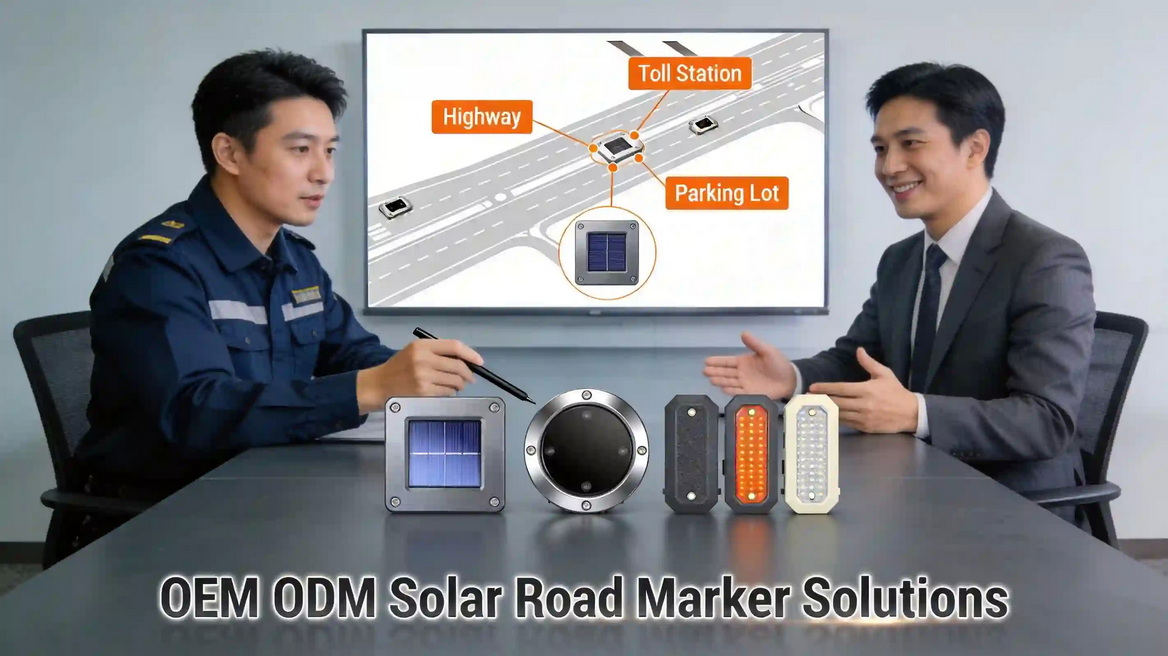
As a dedicated Chinese manufacturer of solar road markers and related traffic‑safety products, Shenzhen Xingsheng Traffic Facilities Co., Ltd. can support international buyers with tailored energy‑storage configurations, housing designs, and optical features. Leveraging OEM and ODM capabilities, the company can design:
- Ni‑MH‑based solar studs optimized for cost‑effectiveness and standard duty cycles.
- Supercapacitor‑based solar studs engineered for long service life, high reliability, and demanding climate conditions.
For EPC contractors, distributors, and road‑safety solution providers, partnering with a flexible OEM allows alignment of product specification with regional standards, tender requirements, and branding strategies.
For road‑safety planners, engineering firms, and distributors, the choice between Ni‑MH rechargeable batteries and supercapacitors for solar studs should be based on lifetime expectations, environment, and maintenance realities—not on component cost alone. If you are planning a new project or upgrading existing road markers, consider engaging Shenzhen Xingsheng Traffic Facilities Co., Ltd. to evaluate site conditions, traffic patterns, and budget constraints, and to design an OEM/ODM solar stud solution that balances energy‑storage technology, visibility requirements, and long‑term reliability.
Not always. Supercapacitors excel in long‑life, high‑traffic environments, but Ni‑MH can be more economical for small or temporary projects where maintenance is acceptable.
In optimized designs, service life can approach 10 years, with working times of over 60 hours constant and 110 hours flashing per full charge under suitable conditions.
Ni‑MH batteries are more sensitive to high temperatures and may suffer faster capacity decline on hot asphalt surfaces, increasing replacement frequency.
Yes. Many Chinese manufacturers provide separate Ni‑MH and supercapacitor variants or mixed portfolios, allowing buyers to select configuration per project type.
Emphasize reduced lane‑closure costs, fewer component replacements, and improved night‑time safety performance over the product's lifetime, which often outweigh higher initial unit prices.
1. NOKIN Traffic – "Solar road stud with super capacitor" (Technical overview of supercapacitor solar studs, performance data and lifetime characteristics). https://www.nk-roadstud.com/news/news-information/solar-road-stud-with-super-capacitor.html
2. ScienceDirect – "Supercapacitors and rechargeable batteries, a tale of two…" (Technical comparison of energy‑storage mechanisms, power and energy densities, and cycle life characteristics). https://www.sciencedirect.com/science/article/pii/S2214993724002914
3. Made‑in‑China – "Solar LED Road Marker" category (Market overview of solar road marker manufacturers and product configurations in China). https://www.made-in-china.com/Security-Protection-Catalog/browse-Solar-LED-Road-Marker-25140300000002-3.html
4. Solar Road Markers – "PC Solar Road Markers Company China" (Example of Chinese solar road marker manufacturing capabilities and product applications). https://www.solarroadmarkers.com/pc-solar-road-markers-company-china.html
5. Made‑in‑China – "Solar Led Light With Super Capacitor" (Product listings showing market adoption and pricing trends of supercapacitor‑based solar lighting solutions). https://www.made-in-china.com/products-search/hot-china-products/Solar_Led_Light_With_Super_Capacitor.html
6. Made‑in‑China – "Ni-MH Battery Solar Led" and "Ni Mh Battery Solar Lamp" (Ni‑MH battery applications and indicative pricing in solar lighting products). https://m.made-in-china.com/hot-china-products/Ni-MH_Battery_Solar_Led.html
7. HiSupplier – "Solar road marker" (General overview of solar road marker products and use cases). https://www.hisupplier.com/a-solar-road-marker/


