
Please Choose Your Language
Views: 239 Author: XS Traffic Facilities Publish Time: 2026-07-01 Origin: Site


Content Menu
● Understanding Road Stud Types and Materials
● Key Road Stud Types (Function-Based)
>> 1. Reflective Road Studs (Conventional Types)
>> 3. Wired and Smart Wireless Road Studs
● Main Road Stud Materials (Performance-Based)
>> Plastic Road Studs (ABS / PC)
>> Cast Iron and Heavy-Duty Hybrids
● Types vs. Materials: What Really Matters on the Road?
● Expert Installation Insights from the Field
● Case Study: Upgrading from Plastic to Aluminum Solar Studs
● OEM/ODM Perspective: How We Match Types and Materials to Projects
● Practical Buying Checklist for Road Stud Types and Materials
● Call to Action for B2B Buyers
● FAQs about Road Stud Types and Materials
>> 1. What is the difference between reflective and solar road studs?
>> 2. Which material is best for high-traffic highways?
>> 3. How long do road studs usually last?
>> 4. Are temporary road studs safe for highways?
>> 5. How important is installation quality compared to material choice?
As a Chinese OEM/ODM manufacturer of road reflectors and traffic safety products, I see one mistake over and over again in overseas projects: buyers focus on road stud *types* (solar, reflective, smart) but underestimate how materials (aluminum, plastic, ceramic, glass) decide lifespan, maintenance cost, and real-world safety performance. In this guide, I'll compare road stud types and materials from a practitioner's perspective, so procurement teams, distributors, and engineers can make data‑driven choices—not just price‑driven ones.
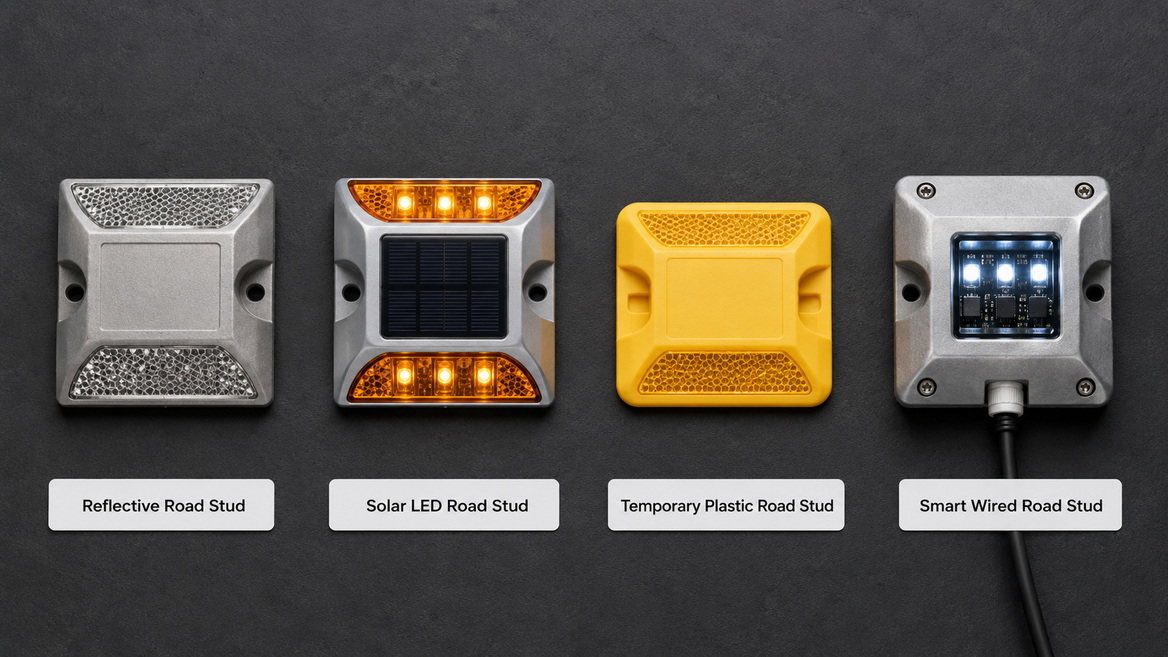
Road studs (also called raised pavement markers, road reflectors, or cat's eyes) are retro‑reflective devices installed on road surfaces to enhance lane guidance and visibility, especially at night and in adverse weather. They are now standard on streets, highways, toll stations, and parking lots worldwide.
From both project and manufacturing sides, there are two core dimensions you must understand:
- By type/function: Reflective, solar LED, wired, smart wireless, temporary, etc.
- By material: Aluminum, plastic (ABS/PC), ceramic, glass, cast iron, and hybrids.
A high‑speed toll road in a rainy coastal area will not use the same combination as a low‑speed parking lot. As an OEM/ODM supplier, our design discussions almost always start from the interaction between type and material, not either in isolation.
From an engineering and procurement perspective, the most commercially relevant types today are:
- Reflective road studs (non‑powered)
- Solar LED road studs (self‑powered)
- Wired or smart road studs (connected, less common)
- Temporary adhesive road studs (short‑term delineation)
These are the classic "cat's eyes" that rely on vehicle headlights and retro‑reflective lenses, not electricity. They are widely specified for:
- Lane separation on highways
- Center lines and edge lines
- Toll station approach lanes
- Parking bay markings
Pros (from a manufacturer's view):
- Low unit cost and simple installation.
- No wiring, no battery, minimal failure points.
- Compatible with almost any climate and pavement type.
Cons:
- Visibility drops in heavy rain, fog, or complex curves vs strong LED studs.
- Performance heavily depends on lens cleanliness and retro‑reflective quality.
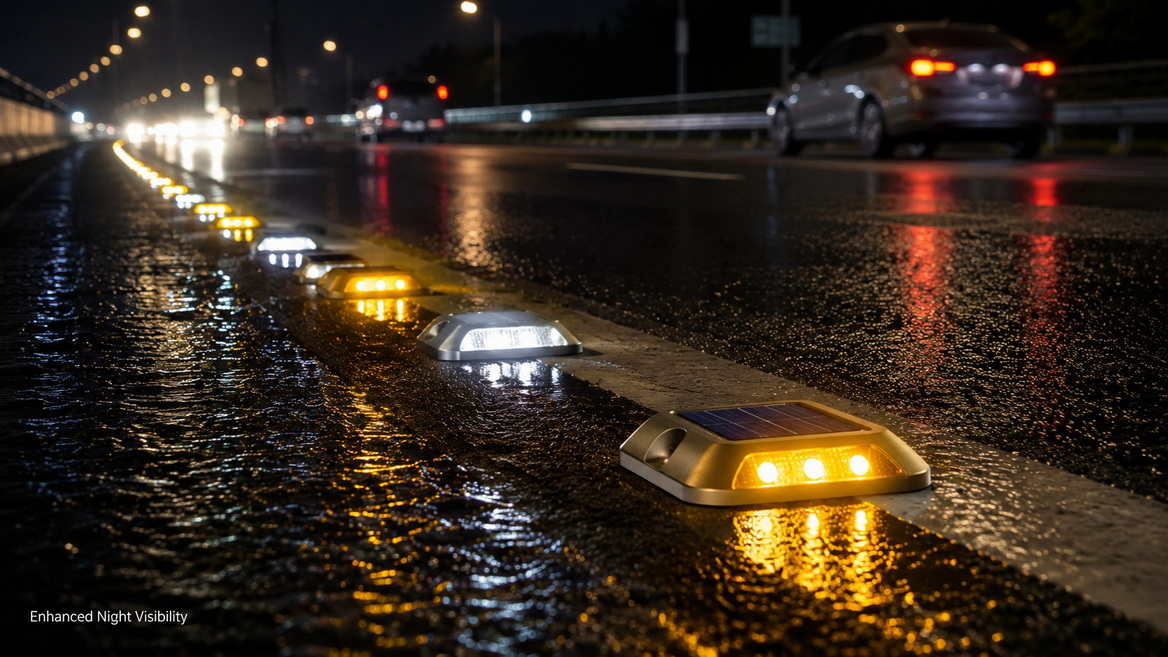
Solar road studs integrate a solar panel, battery, LED, and often an aluminum or high‑impact housing. They produce active light and stay visible even when the road is wet or headlight glare is poor.
Typical use cases:
- Curves and ramps on high‑speed highways
- Hazardous blackspots and accident‑prone segments
- Tunnel entrances, bridge edges, fog‑prone corridors
- Premium parking areas and logistics yards
Pros:
- Much higher visual range and conspicuity at night.
- Can operate off‑grid and reduce reliance on overhead lighting.
- Various flashing modes to draw driver attention.
Cons:
- Higher upfront cost per unit.
- Battery life typically 5–8 years, requires periodic replacement.
- Performance is sensitive to solar exposure and sealing quality.
These studs integrate power and communication for dynamic control, often linked to traffic management systems.
Use cases:
- Smart city pilot projects
- Airport taxiways and high‑end tunnels
- Dynamic lane control, reversible lanes
From a manufacturer perspective, this category is still niche and highly project‑specific, usually requiring custom ODM design and integration with the client's control systems.
Temporary studs use self‑adhesive or hot‑melt bases and are designed for construction zones, detours, or short‑term traffic schemes.
Key features:
- Fast manual installation, minimal surface preparation.
- Often plastic with moderate reflectivity and lower mechanical strength.
- Designed for easy removal with limited pavement damage.
Alongside types, materials define impact resistance, lifespan, and cost of ownership. The most common choices are:
- Aluminum and other metals
- Plastic (ABS, polycarbonate)
- Ceramic
- Glass and acrylic lenses
- Cast iron (for heavy duty)
Aluminum is widely used for both reflective and solar studs on busy highways.
Characteristics:
- High compressive strength and impact resistance under heavy loads. - Good heat dissipation for solar electronics. - Often used with glass or acrylic reflective lenses.
Typical lifespan:
- 10–15 years or more under normal traffic with proper installation.
Plastic studs, usually made of ABS or polycarbonate, are popular for cost‑sensitive or low‑speed applications.
Characteristics:
- Lightweight and easy to handle on site. - Lower raw material and tooling cost.
- Moderate impact resistance; can deform or crack under very heavy trucks.
Typical lifespan:
- Around 2–5 years depending on traffic and climate.
Ceramic studs are often used in urban or moderate‑speed environments.
Characteristics:
- Hard, abrasion‑resistant surface with good durability. - Often paired with embedded reflective elements.
- Good color stability and skid resistance.

Few studs are fully made of glass; most use glass or acrylic lenses integrated into a metal or plastic body.
Characteristics:
- High retro‑reflectivity when clean. - Tempered glass or robust acrylic improves impact resistance. - Susceptible to contamination by dust, rubber, or snow chemicals, so cleaning matters.
For extremely high‑load environments (ports, industrial yards, heavy trucks), cast iron or reinforced metal bodies are used.
Characteristics:
- Very high mechanical strength and service life. - Often combined with reflective inserts or LEDs.
- Higher material and installation cost, sometimes with mechanical fixing.
To help B2B buyers and engineers see the trade‑offs clearly, here is a structured view from both safety and life‑cycle cost perspectives based on commonly cited industry data.
| Application Scenario | Recommended Type | Preferred Material | Visibility Performance | Typical Lifespan | Cost Level |
|---|---|---|---|---|---|
| High-speed highways | Reflective or Solar LED | Aluminum / Metal | High to very high at nighttheconstructor+1 | 10–15 years for metal bodyrctraffic | Medium to high |
| Toll stations | Solar LED + Reflective | Aluminum + Plastic mix | Very high, especially on approacheswistronchina+1 | 5–10 years depending on designrctraffic | Medium to high |
| Urban streets | Reflective studs | Plastic or Ceramic | Medium to hightheconstructor+1 | 2–8 yearsstarsplastic+1 | Low to medium |
| Parking lots | Reflective studs | Plastic | Medium, sufficient at low speedstarsplastic | 2–5 yearsrctraffic | Low |
| Construction zones | Temporary studs | Plastic, Self-adhesive | Medium, short-term usescribd+1 | Months to 1–2 years | Low |
| Smart city projects | Smart wired/wireless | Aluminum/Metal | Very high, controllablenokinsolarroadstud+1 | Project dependent | High |
As a manufacturer, we often advise distributors to treat type as the "safety and visibility" decision, and material as the "durability and total cost of ownership" decision. Combining them correctly is the fastest way to avoid premature failures and unnecessary maintenance budgets.
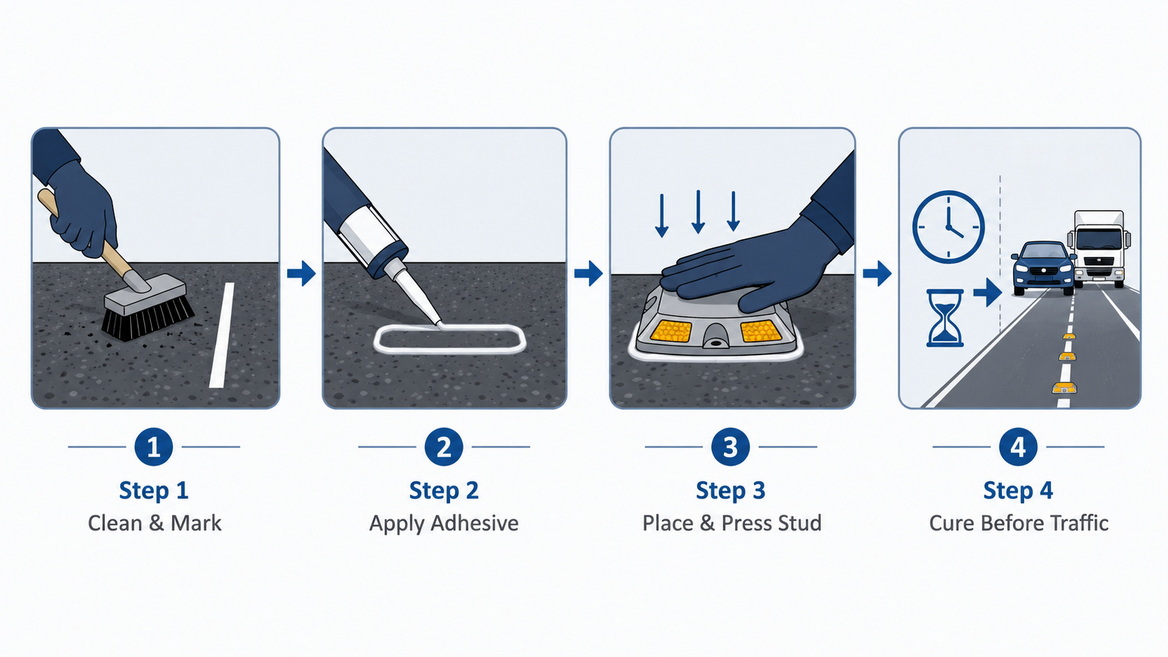
No matter how advanced the type or how robust the material, poor installation will destroy performance. Industry guides consistently highlight three core factors:
1. Surface preparation
- Clean, dry, and dust‑free pavement is essential before bonding. - Oil spots, laitance, and loose aggregate must be removed.
2. Adhesive selection and application
- Two‑component epoxy or hot‑melt bitumen are common for permanent studs.
- Adhesive coverage should slightly exceed the footprint of the stud base.
3. Positioning, alignment, and curing
- Studs must align with the designed lane line and remain level with the pavement. - Traffic should be restricted until adhesive has fully cured to prevent displacement.
From our OEM experience, many field failures blamed on "weak material" are in fact caused by incorrect hole size, insufficient adhesive, or rushed curing during night‑shift installations. We now routinely provide installation drawings and on‑site training support to overseas partners to reduce this risk.
On a recent export project, a highway operator initially used plastic reflective studs in a coastal, high‑rainfall region. Within three years, more than half had lost reflectivity or were physically damaged by heavy truck traffic.
When the road was resurfaced, they upgraded to aluminum solar LED road studs with high‑intensity LEDs and robust sealing:
- Night‑time visibility improved significantly in wet weather and on sharp curves. - Maintenance intervals extended, with fewer replacements over a projected 8–10‑year cycle. - Complaints from drivers about lane visibility on rainy nights dropped after the upgrade, according to post‑implementation feedback.
This is a typical example of how switching both type (reflective → solar) and material (plastic → aluminum) can transform safety performance on the same road alignment.
As an export‑oriented manufacturer of solar road markers, road reflectors, LED traffic signs, and parking safety facilities, we work with distributors and engineering companies from project concept to mass production.
From an OEM/ODM standpoint, we typically follow this process:
1. Clarify safety and visibility requirements
- Design speed, traffic mix, accident history, weather profile, and existing markings.
2. Select road stud type
- Reflective vs solar vs smart, fixed vs temporary, uni‑directional vs bi‑directional.
3. Choose optimal material combination
- Aluminum or cast iron bodies for high‑load, high‑speed roads. - Plastic or ceramic options for urban streets and parking areas.
4. Customize design (ODM)
- Lens size, LED color sequence, screw holes, cable routing, or branding.
- Compliance with local standards and tender specifications.
5. Support installation and long‑term maintenance planning
- Provide installation guides, spacing recommendations, and replacement strategies based on material durability.
For B2B buyers, this manufacturer‑side perspective is crucial: by aligning functional type and material strength at the design stage, your project avoids "cheap first, expensive later" traps.
When our overseas partners are preparing a new tender or sourcing program, these are the key questions we recommend asking internally:
1. Traffic and speed
- Is this a low‑speed parking area, or a 120 km/h freeway segment?
- Heavy trucks or mostly passenger cars?
2. Climate and environment
- High rainfall, snow, or intense UV exposure?
- Coastal salt spray or desert dust conditions?
3. Visibility requirements
- Is passive reflection enough, or do you need active LED guidance on curves and ramps?
4. Design lifespan and maintenance strategy
- Is the target service life 3–5 years, or 10+ years?
- Can you accept battery replacement cycles for solar studs?
5. Budget and total cost of ownership
- Are you optimizing for lowest initial cost, or lowest cost per year of service?
Once you answer these, the choice between plastic or aluminum, reflective or solar, temporary or permanent becomes much clearer, and you can work with an OEM/ODM manufacturer to fine‑tune a solution.
If you are planning a new highway, toll station, or parking project, now is the best time to review whether your current road stud type and material choices truly match your safety, budget, and maintenance expectations. By partnering with an experienced OEM/ODM manufacturer of road reflectors, solar road markers, and LED traffic safety products, you can customize a solution that delivers consistent visibility and long‑term durability—not just low unit prices.
Reach out with your project drawings, design speed, and environmental conditions, and an engineering team can propose a tailored combination of types and materials optimized for your specific application scenario.
Reflective studs rely solely on vehicle headlights and retro‑reflective lenses, while solar studs generate their own light using integrated LEDs, solar panels, and batteries. Solar studs provide much higher visibility in rain, fog, and complex curves but have higher upfront cost and require battery life management.
For high‑speed, heavy‑traffic highways, aluminum or other metal‑body studs—especially when combined with robust reflective lenses or LEDs—are typically recommended due to their high impact resistance and long service life. Plastic can be used on lighter or lower‑speed roads but tends to wear faster under heavy trucks.
Lifespan varies widely: plastic studs often last about 2–5 years, while aluminum or cast iron studs can last 10–15 years or more with correct installation. Solar studs usually have casing life similar to metal studs, but their batteries typically need replacement after around 5–8 years.
Temporary studs are designed for short‑term applications such as roadworks and detours, using self‑adhesive or hot‑melt bases. They are safe when installed correctly but are not a substitute for permanent, high‑strength studs on long‑term highway projects.
Installation quality is equally important: even the strongest aluminum stud can fail early if surface preparation, adhesive selection, or curing time is incorrect. Conversely, well‑installed plastic studs can deliver their full expected service life when used in appropriate environments.


