
Please Choose Your Language
Views: 234 Author: XS Traffic Facilities Publish Time: 2026-09-14 Origin: Site


Content Menu
● What Is Emergency Vehicle Traffic Signal Preemption?
>> Emergency Vehicle Preemption vs. Signal Priority
● How Do Emergency Vehicles Change Traffic Lights?
>> Why an Emergency Vehicle May Still Wait at a Red Light
● Technologies Used for Emergency Vehicle Preemption
>> Optical and Infrared Preemption Systems
>> GPS, Radio, and Cellular Preemption Systems
>> Acoustic and Siren-Detection Systems
>> Connected Vehicle and Smart Intersection Systems
● Can Every Emergency Vehicle Change Every Traffic Light?
>> Emergency Drivers Must Still Use Defensive Driving
● Safety Engineering Before the Signal Turns Green
● How Solar Traffic Lights Support Traffic Safety Projects
>> Typical Applications for Solar Traffic Lights
>> Questions to Ask Before Selecting Solar Traffic Lights
● Common Myths About Emergency Vehicle Traffic Lights
>> "Every ambulance can make traffic lights turn green."
>> "A traffic signal turns green immediately after detecting an emergency vehicle."
>> "A siren always changes the traffic light."
>> "Emergency preemption means emergency drivers can ignore all intersection risks."
>> "Solar traffic lights are only for temporary construction areas."
>> "Any traffic light can be upgraded for emergency preemption."
● Summary
>> Can emergency vehicles really change traffic lights?
>> Do fire trucks and ambulances always receive green lights?
>> How long does it take for a traffic light to change for an emergency vehicle?
>> What is the difference between emergency preemption and traffic signal priority?
>> Can solar traffic lights support emergency vehicle preemption?
Yes, authorized emergency vehicles can request changes to traffic signals—but they cannot simply control every traffic light they approach. Where compatible infrastructure is installed, emergency vehicle preemption can temporarily adjust traffic signal operation, clear conflicting movements, and give an approaching ambulance, fire truck, or police vehicle a safer route through an intersection.
For public agencies, road contractors, emergency-service fleets, and traffic-safety project buyers, the important question is not simply whether a vehicle can change a light. The real question is whether the full system—including the emergency vehicle, communication method, traffic controller, intersection layout, power supply, and operating policy—can work together safely and reliably.

Emergency vehicle traffic signal preemption is a traffic-management function that temporarily changes a traffic signal's normal operating sequence to give an authorized emergency responder priority at an intersection.
In practical terms, the system receives a request from an approaching emergency vehicle and then prepares the intersection for its movement. It may shorten the current traffic phase, display yellow to conflicting traffic, hold all directions red for a clearance period, and then provide a green signal for the emergency vehicle's direction of travel.
The goal is simple: reduce delay while protecting all road users.
Emergency vehicle preemption is commonly used for:
- Ambulances and emergency medical service vehicles
- Fire engines, rescue trucks, and ladder vehicles
- Police vehicles responding to urgent incidents
- Hazardous-material response vehicles
- Disaster-response fleets
- Selected public-safety vehicles operating under authorized conditions
However, not every emergency vehicle is equipped with a preemption transmitter, and not every traffic signal can receive or process a request. A flashing beacon, siren, or emergency light does not automatically make a traffic signal change.
Emergency vehicle preemption and traffic signal priority are related, but they serve different purposes.
| Feature | Emergency Vehicle Preemption | Traffic Signal Priority |
|---|---|---|
| Typical users | Ambulances, fire vehicles, police, rail vehicles | Transit buses, freight fleets, bicycles, managed vehicles |
| Primary purpose | Urgent and safe emergency response | Improved traffic flow or schedule reliability |
| Effect on signal timing | Can temporarily override normal operation | Makes limited timing adjustments where possible |
| Treatment of conflicting traffic | Conflicting movements are stopped and cleared | Conflicting movements may experience minor delays |
| Intersection control | Takes control of the signal sequence | Works within existing signal operations when possible |
| Urgency level | Emergency situation | Operational preference |
Preemption is more disruptive, but it is designed for more urgent situations. Signal priority may extend a green phase for a bus or shorten a red phase, while preemption may interrupt the normal signal plan to create a safe passage for an emergency vehicle.
Emergency vehicles generally do not change signals instantly. A safe traffic-signal preemption process includes several programmed stages to make sure drivers, cyclists, and pedestrians have time to clear the intersection.
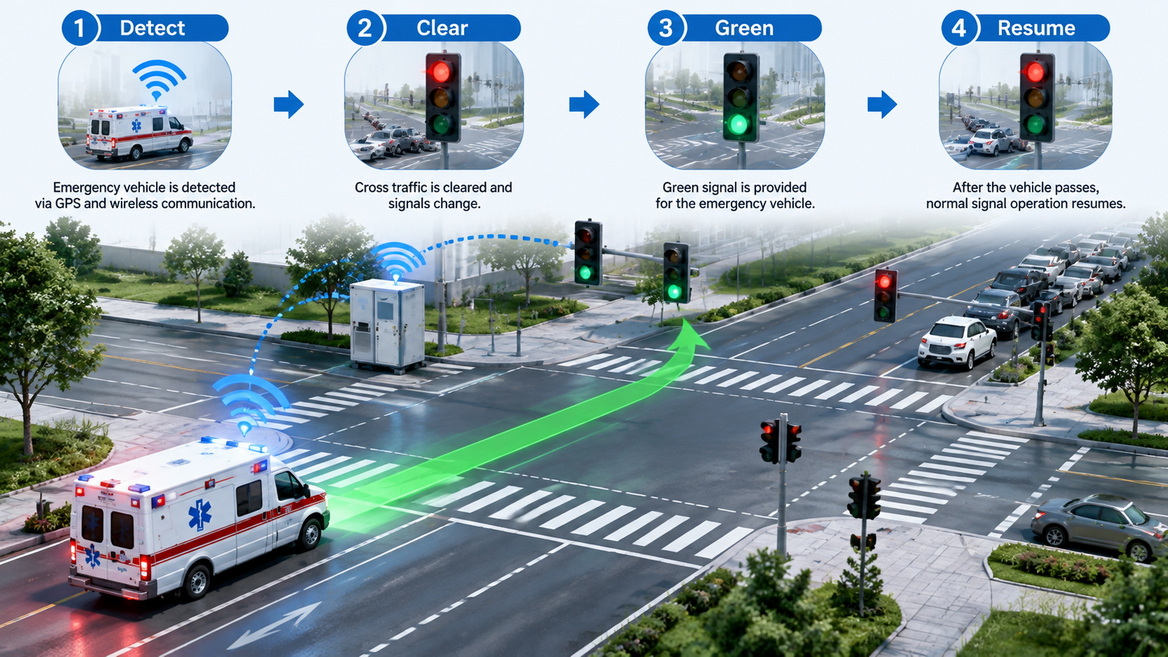
A typical sequence includes the following steps:
1. The emergency vehicle sends a request.
An authorized onboard device transmits information about the vehicle, travel direction, location, or emergency-response status.
2. The intersection receives and validates the request.
A roadside receiver, wireless communication device, signal controller, or traffic-management platform receives the request.
3. The signal controller begins a safe transition.
The system does not immediately switch all other directions from green to red. It first applies required yellow and all-red clearance intervals.
4. Conflicting movements are stopped.
Vehicles moving across or against the emergency vehicle's route receive a red signal after the clearance sequence is completed.
5. The emergency approach receives a green signal.
The controller provides a green phase or protected movement for the approaching emergency vehicle.
6. The signal returns to normal operation.
After the emergency vehicle has passed, the controller follows its programmed recovery process and resumes normal traffic coordination.
This sequence is essential because intersections remain high-risk locations even when an emergency vehicle has priority. Drivers may be distracted, unable to see the approaching vehicle, uncertain about how to react, or already committed to turning movements.
A short delay does not necessarily mean that the preemption system has failed. In many cases, the controller is completing its safety sequence before releasing the requested movement.
An emergency vehicle may wait briefly because:
- Cross traffic is completing a yellow interval.
- The intersection requires an all-red clearance period.
- Pedestrians are still crossing.
- The emergency vehicle is outside the detection range.
- The signal is not equipped with compatible preemption hardware.
- The onboard vehicle equipment is not active.
- Multiple emergency requests are competing at the same intersection.
- The intersection is operating under a temporary fault, maintenance mode, or special traffic plan.
- The signal controller needs to complete a programmed transition before serving the request.
A well-designed system prioritizes safe clearance before emergency movement. That short delay can prevent a serious side-impact collision.
Different emergency vehicle preemption technologies are used around the world. The right solution depends on local infrastructure, traffic volume, road layout, weather conditions, fleet size, maintenance capability, and communication requirements.
Optical preemption systems use a coded light emitter mounted on an authorized emergency vehicle. A receiver installed near the traffic signal detects the coded flash pattern and sends a preemption request to the signal controller.
These systems have been used for many years and remain common in certain cities and corridors.
Key advantages include:
- Established and widely understood technology
- Directional vehicle detection
- Fast response when the vehicle is within range
- Suitable for defined intersection approaches
- Can be integrated with selected existing traffic-signal systems
Potential limitations include:
- Clear line of sight is often required.
- Buildings, trees, large vehicles, bridges, weather conditions, and intersection geometry can affect detection.
- Equipment alignment must be checked regularly.
- Multiple receivers may be needed to cover all approaches.
- The installation may be less flexible in complex urban environments.
Optical systems can work effectively where road geometry is predictable and the receiver has a clear view of approaching emergency vehicles.
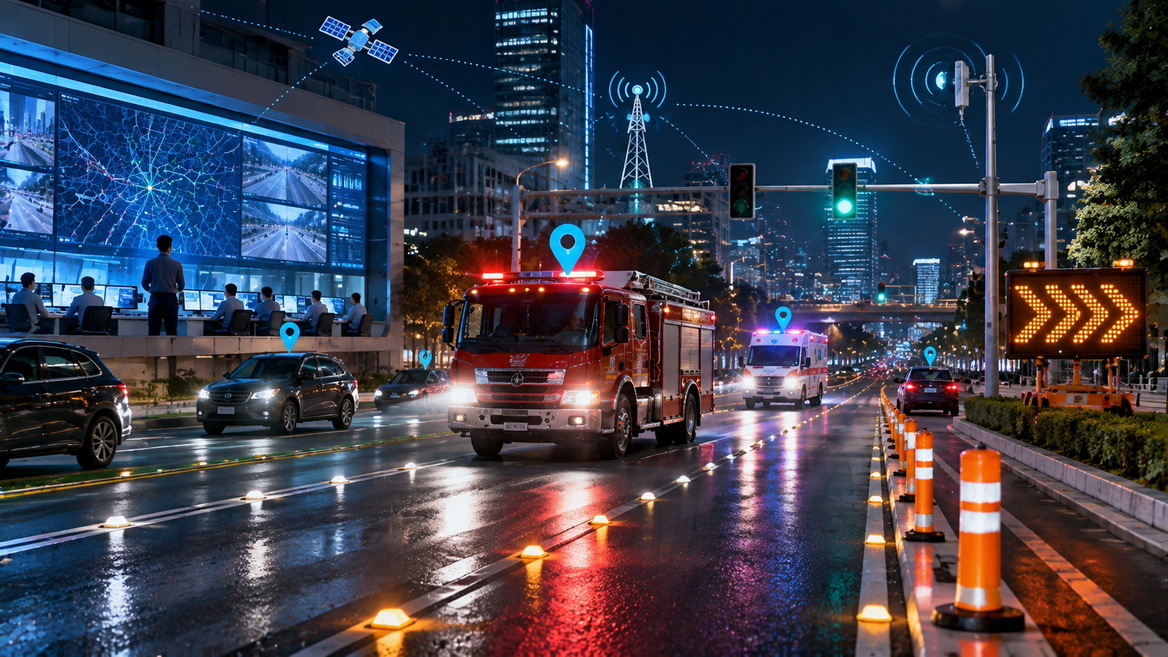
GPS-based and wireless systems use vehicle location, heading, speed, estimated arrival time, and communication networks to request priority at upcoming intersections.
Unlike optical systems, GPS-based solutions do not always depend on a direct line of sight between the vehicle and a roadside receiver. The system can identify the emergency vehicle's route and begin preparing the intersection before the vehicle is physically close to the signal.
Key advantages include:
- Supports corridor-wide coordination
- Can identify vehicle location, direction, and speed
- Reduces dependence on direct optical visibility
- Supports centralized monitoring
- Provides valuable event logs and diagnostic information
- Can assist emergency vehicles on longer routes
- May create a coordinated series of green signals along key response corridors
For large cities, airport access roads, highways, toll stations, and major emergency-response routes, GPS-based preemption can offer a more connected approach to traffic operations.
Acoustic systems use microphones or audio-processing technology to identify emergency sirens. In theory, the system can recognize a siren pattern and request a signal change.
However, acoustic detection must be designed carefully. Urban environments contain many sources of noise, including construction equipment, buses, horns, motorcycles, trains, crowds, and reflected sound from buildings.
Possible challenges include:
- False activations
- Missed detections
- Difficulty identifying vehicle direction
- Reduced reliability in noisy locations
- Interference from multiple sirens
For this reason, acoustic technology is usually evaluated as one component of a broader traffic-management system rather than as a universal answer.
Connected traffic systems allow emergency vehicles to communicate with roadside equipment, cloud platforms, traffic-management centers, or smart signal controllers.
These systems can support more detailed information exchange. For example, a vehicle may communicate its position, emergency status, route, direction, estimated arrival time, and requested movement. The traffic controller can then prepare the intersection and, in some cases, coordinate adjacent intersections.
This approach is especially valuable for:
- Smart-city traffic projects
- Urban emergency-response corridors
- Connected intersections
- Major arterial roads
- Toll plazas and highway access routes
- Large industrial parks
- Airport, port, and logistics facilities
- Temporary incident-management operations
No. Emergency vehicle preemption is not available at every traffic signal.
The system only works when the vehicle, communication technology, signal controller, intersection equipment, and local operating policy are compatible.
For example, an ambulance may have a working onboard preemption unit, but the signal ahead may not respond if:
- The intersection does not have a compatible receiver or communication device.
- The traffic controller is not configured for emergency preemption.
- The signal belongs to another road authority using a different system.
- The equipment is being maintained or repaired.
- The vehicle is outside the configured detection zone.
- The vehicle is traveling in an unrecognized direction.
- The request cannot be verified by the system.
- A competing emergency request has already been accepted.
- The signal is operating as a temporary construction signal without the required interface.
- Local authorities do not permit that vehicle type to use preemption.
This is why a city may have preemption on selected response corridors but not throughout the entire road network.
A preempted green signal does not eliminate all risks. Emergency drivers must still expect unexpected behavior from other road users.
Even after the signal changes, an intersection may contain:
- Vehicles that entered late on yellow
- Drivers who did not hear the siren
- Pedestrians who are still crossing
- Cyclists in a bike lane or crosswalk
- Vehicles blocked in traffic queues
- Motorists making sudden lane changes
- Drivers who panic or stop in an unsafe position
Emergency vehicle operators receive training for these situations. The purpose of preemption is to improve the traffic environment, not to remove the need for professional judgment.
For ordinary road users, the safest response is to stay alert, follow local traffic rules, avoid sudden movements, and never enter an intersection against a red signal unless directed by an authorized officer.
The most important part of traffic signal preemption is what happens before the emergency vehicle receives a green signal.
The system must first prevent conflicts between the emergency route and other movements. In many intersections, this includes a carefully programmed process:
- Ending the active green phase for conflicting vehicles
- Displaying yellow to the traffic losing the right of way
- Activating an all-red clearance interval
- Allowing vehicles already in the intersection to exit
- Managing conflicting pedestrian movements
- Holding cross traffic on red
- Providing a protected green movement to the emergency approach
- Restoring normal traffic coordination after the emergency vehicle passes
This sequence matters because simply changing one approach to green while cross traffic is still moving could create a severe collision risk.
Intersections are not empty spaces. A vehicle may already be turning left, a bus may be clearing a wide crossing, or a pedestrian may be walking through the crosswalk when the preemption request arrives.
A safe controller needs to account for:
- Vehicle speed
- Lane width
- Intersection size
- Turning movements
- Pedestrian crossing time
- Heavy-vehicle stopping distance
- Road gradient
- Weather conditions
- Nighttime visibility
- Queue length
- Nearby railway, toll, or work-zone operations
The best emergency preemption strategy is therefore not always the fastest possible signal change. It is the safest controlled transition that reduces emergency response delay without creating a new hazard.
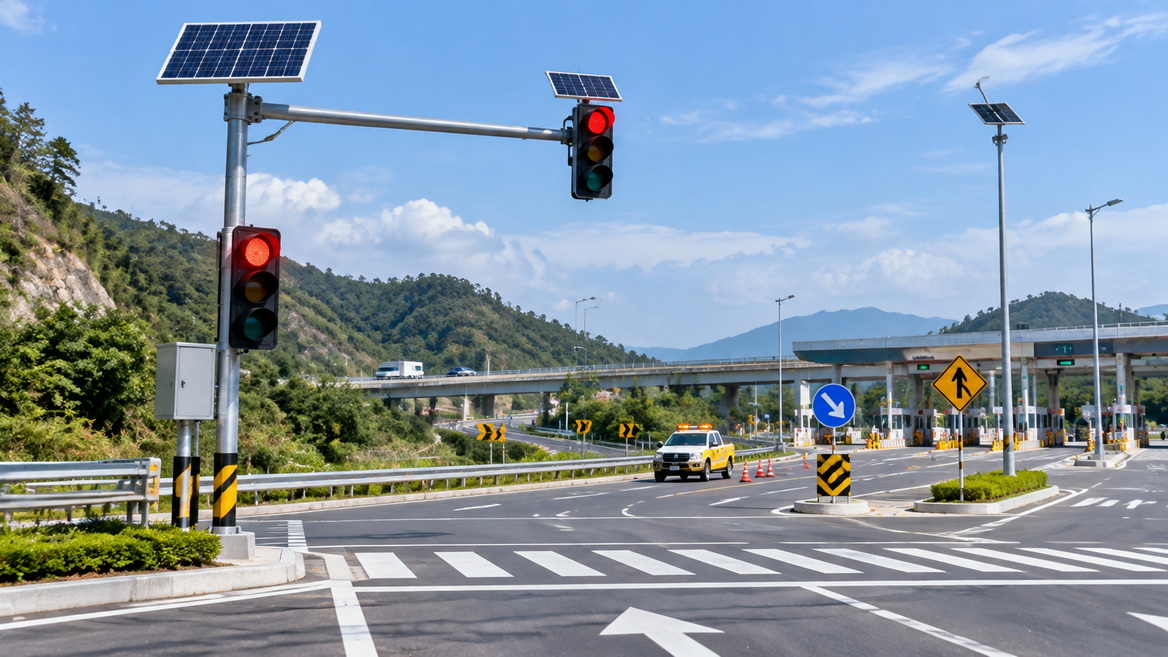
Solar traffic lights are increasingly used in locations where grid power is unavailable, costly to install, unreliable, or unsuitable for temporary traffic control.
A solar traffic light typically uses photovoltaic panels to collect sunlight, stores electrical energy in a battery system, and powers LED signal modules. Depending on the project, it may also include controllers, wireless communication devices, traffic detectors, warning signs, or remote monitoring equipment.
Solar-powered traffic signals are not automatically emergency vehicle preemption systems. However, they can be designed as part of a broader traffic-safety project when the system includes compatible controllers, sufficient battery capacity, reliable communications, and appropriate emergency-response interfaces.
Solar traffic lights can support a wide range of road-safety and traffic-management environments:
- Rural and remote intersections
- Temporary work zones
- Highway maintenance areas
- Toll-station approaches
- Parking lots and parking garage entrances
- Logistics centers and industrial parks
- Construction sites
- School-zone crossings
- Event traffic-control areas
- Private roads and gated communities
- Temporary disaster-response locations
- Remote access roads with limited grid infrastructure
For each project, the design should consider local solar resources, weather conditions, daily operating hours, battery autonomy, LED power consumption, visibility distance, pole configuration, and required maintenance intervals.
Before choosing a solar traffic signal solution, project buyers should define the real operating conditions.
1. How many hours per day will the system operate?
2. How many consecutive low-sunlight days must the battery support?
3. Will buildings, trees, trucks, signs, or elevated structures create shading?
4. Does the project require fixed installation, a portable trailer-mounted unit, or a temporary work-zone signal?
5. What LED lens diameter, brightness, color, and visibility distance are required?
6. Does the site need wireless communication, remote monitoring, or emergency preemption compatibility?
7. What mounting height, pole type, and wind-resistance level are required?
8. Are there local standards for traffic signal appearance, flash patterns, electrical safety, and installation?
9. What maintenance access is available after installation?
10. Does the project require customized housing, branding, packaging, wiring, controller logic, or mounting accessories?
Answering these questions early helps prevent a mismatch between the selected product and the actual road environment.
Not true. The vehicle and the intersection must both have compatible equipment and approved operating permissions.
Not usually. The controller normally needs to complete yellow and all-red clearance intervals before safely serving the emergency route.
Not true. Many systems use coded optical signals, GPS, radio, cellular communications, or connected traffic platforms rather than siren detection.
Not true. Preemption improves the intersection environment, but emergency drivers still need to proceed carefully and expect unpredictable road-user behavior.
Not true. Solar-powered traffic signals can support temporary, remote, private-site, and selected permanent applications when the power system is properly designed.
Not always. Compatibility depends on the signal controller, communication technology, power system, agency requirements, existing equipment, and local project specifications.
Emergency vehicles can change traffic lights in selected locations through authorized preemption systems. These systems use technologies such as optical emitters, GPS, radio communications, cellular networks, and connected traffic platforms to request a safer path through signalized intersections.
The process is not instant. A properly programmed controller must first clear conflicting traffic, manage pedestrian movements, apply yellow and all-red intervals, and then provide a green phase for the emergency vehicle.
For streets, highways, toll stations, parking facilities, industrial zones, and temporary traffic-control projects, reliable traffic equipment is only one part of the solution. Effective traffic safety depends on appropriate signal design, compatible controllers, dependable power, visibility, communication methods, and site-specific engineering.
Shenzhen Xingsheng Traffic Facilities Co., Ltd. provides solar traffic lights and related traffic-safety products for road, highway, toll-station, parking, and project-based applications. OEM and ODM options can be developed according to the required traffic-control method, solar power configuration, mounting structure, controller requirement, environmental conditions, and project specifications.
Yes. Authorized emergency vehicles can request traffic-signal preemption at intersections equipped with compatible systems. The signal controller temporarily changes its normal timing sequence to provide a safer route for the approaching emergency vehicle.
No. The vehicle must be equipped with an approved request device, and the intersection must have compatible equipment. The traffic signal may also need time to complete a safe clearance sequence before changing.
The timing depends on the current signal phase, yellow interval, all-red clearance time, pedestrian activity, intersection geometry, and system programming. In many cases, the vehicle may experience a short delay while conflicting traffic clears.
Emergency preemption can temporarily override normal signal operations to serve urgent emergency vehicles. Traffic signal priority usually makes smaller adjustments, such as extending a green phase for transit vehicles, without taking full control of the intersection.
Yes, in certain applications. A solar traffic light system can support preemption if it has compatible controllers, communication equipment, sufficient power capacity, and the appropriate traffic-control interface.
1. Federal Highway Administration, "Traffic Signal Timing Manual: Chapter 9 — Signal Priority and Preemption."
[https://ops.fhwa.dot.gov/publications/fhwahop08024/chapter9.htm]
2. Federal Highway Administration, "Giving First Responders the Green Light."
[https://www.fhwa.dot.gov/innovation/innovator/issue99/page_03.html]
3. Washington State Department of Transportation, "Traffic Signal Priority & Preemption."
[https://tsmowa.org/category/intelligent-transportation-systems/traffic-signal-priority-preemption]
4. Washington State Department of Transportation, "Emergency Vehicle Preemption."
[https://tsmowa.org/category/intelligent-transportation-systems/emergency-vehicle-preemption]
5. Purdue University, "Recent Developments in Emergency Vehicle Traffic Signal Preemption."
[https://docs.lib.purdue.edu/cgi/viewcontent.cgi?article=4091&context=roadschool]
6. U.S. Department of Transportation, "Traffic Signal Preemption for Emergency Vehicles: A Cross-Cutting Study."
[https://rosap.ntl.bts.gov/view/dot/3655]
7. JACKWIN, "Can Emergency Vehicles Change Traffic Lights? 6 Ways."
[https://jackwinsafety.com/can-emergency-vehicles-change-traffic-lights/]
8. JACKWIN, "Solar Traffic Light Manufacturer in China."


