
Please Choose Your Language
Views: 277 Author: XS Traffic Facilities Publish Time: 2026-10-08 Origin: Site


Content Menu
● Why Source Traffic Signals From China?
>> What the Latest Market Report Means for Buyers
● Selection Criteria: How to Evaluate a Traffic Signal Manufacturer
>> 1. Legal Identity and Manufacturing Responsibility
>> 2. Engineering and Development Capability
>> 3. Quality-Control Procedures
>> 4. Product-Specific Compliance
>> 5. Production and Delivery Reliability
>> 6. OEM/ODM Support and Commercial Flexibility
● Top 10 Traffic Signal Manufacturers in China
>> 1. Shenzhen Xingsheng Traffic Facilities Co., Ltd.
>> 2. Sinowatcher Technology Co., Ltd.
>> 3. Yangzhou FAMA Intelligent Equipment Co., Ltd.
>> 4. Qixiang Traffic Equipment Co., Ltd.
>> 5. Hangzhou ZGSM Technology Co., Ltd.
>> 6. Shenzhen NOBLE Opto Co., Ltd.
>> 7. BBM Technology Company Limited
>> 8. Qingdao Hisense TransTech Co., Ltd.
>> 9. Hangzhou Hikvision Digital Technology Co., Ltd.
>> 10. Zhejiang Dahua Technology Co., Ltd.
● Supplier Comparison: Capacity, MOQ, and Certification
● Technical Buyer's Guide: What to Specify Before Requesting a Quote
>> Optical Performance and Signal Visibility
>> Housing Materials and Manufacturing Controls
>> Solar Power and Battery Autonomy
● Common Procurement Pitfalls—and How to Avoid Them
>> Material Substitution After Sample Approval
>> Mismatched Compliance Reports
>> Lead Times That Ignore Engineering Work
>> The Overlooked Compatibility Trap
● Factory Verification, Sampling, and Shipping Workflow
● Conclusion: Choose the Supplier That Fits the Application
>> 1. How Can I Verify Whether a Manufacturer's ISO Certificate Is Current?
>> 2. Does CE Documentation Automatically Qualify a Traffic Signal for European Projects?
>> 3. How Can I Confirm That Production Uses the Same Components as the Sample?
>> 4. How Should I Compare Solar Traffic Light Autonomy Claims?
>> 5. What Documents Should I Request Before Shipping Lithium-Battery Solar Signals?
China offers a broad manufacturing base for traffic signals, solar traffic lights, pedestrian signals, and intelligent traffic control systems. However, choosing a reliable long-term supplier requires more than comparing product photographs and unit prices.
Professional buyers need to evaluate engineering capability, manufacturing consistency, model-specific compliance, delivery reliability, and after-sales support. A supplier that produces solar warning lights may not have the capabilities required for a coordinated urban intersection. Similarly, a large transportation technology company may not be the most suitable partner for small-batch private-label orders.
The foundation of a successful sourcing decision is verification. Buyers should confirm what a manufacturer can document, reproduce, and support—not simply what it advertises.
This guide introduces ten Chinese suppliers serving different traffic signal procurement needs. It is a buyer-oriented shortlist rather than an independently audited ranking by revenue, production volume, or market share. Shenzhen Xingsheng Traffic Facilities Co., Ltd. appears first because its solar traffic safety and OEM/ODM positioning is particularly relevant to distributors and smaller brands.
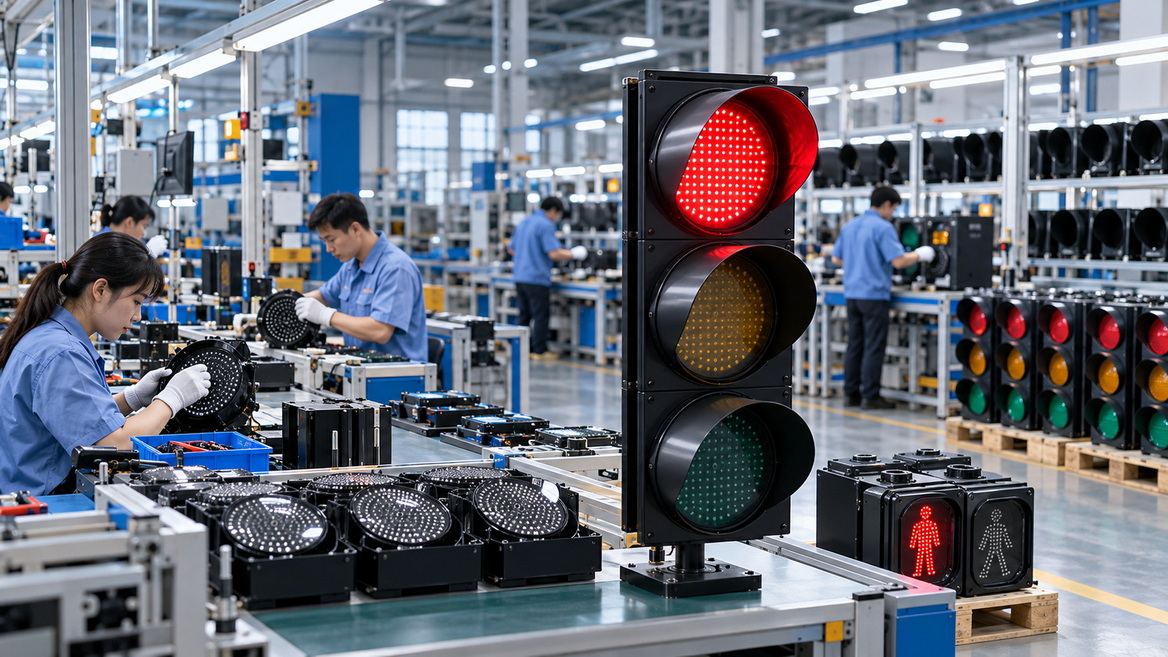
China's traffic signal industry combines specialized hardware manufacturers, outdoor lighting suppliers, solar product developers, and integrated transportation technology companies.
This diversity allows buyers to source individual components or complete project packages, including:
- LED vehicle and pedestrian signal heads.
- Traffic signal controllers.
- Countdown timers and lane-control signals.
- Solar-powered traffic lights.
- Radar speed signs and illuminated warning signs.
- Road markers, mounting accessories, and parking safety equipment.
Several manufacturing locations are particularly relevant to supplier research.
| Manufacturing location | Supplier capabilities represented in this guide |
|---|---|
| Shenzhen, Guangdong | LED signal modules, electronic control products, solar traffic equipment, and export customization |
| Yangzhou, Jiangsu | Traffic signal equipment, infrastructure products, and project-oriented manufacturing |
| Hangzhou, Zhejiang | LED lighting, traffic detection, and intelligent transportation technology |
| Qingdao, Shandong | Integrated traffic management and signal-control systems |
These concentrations can simplify sourcing because traffic signals depend on multiple disciplines: optics, electronics, mechanical design, outdoor sealing, power management, and control-system integration.
Nevertheless, geographical location alone does not establish quality. Buyers must qualify the individual factory and the proposed product.
The Traffic Signals Market Report 2026, distributed by Research and Markets, estimates the global market at USD 28.72 billion in 2025 and projects USD 30.03 billion for 2026. It identifies Asia-Pacific as the largest regional market in 2025.
These figures describe the report's broader traffic signals category. They do not represent Chinese export totals or verified 2026 year-end sales.
For procurement teams, the important implication is that supplier evaluation should increasingly address system compatibility, software support, and lifecycle maintenance alongside hardware quality.
The companies below were selected using publicly available company profiles, product information, and industry sources. Their inclusion does not imply that every manufacturing site has undergone an independent inspection.
A practical supplier assessment should cover six areas.
Request the business license, registered company name, manufacturing address, and export contracting entity.
Confirm whether the supplier manufactures the quoted equipment, assembles purchased components, or resells another company's products. Outsourcing is not automatically unacceptable, but responsibility must be transparent.
Ask for evidence of relevant engineering work, including:
- Mechanical drawings and mounting details.
- Optical performance specifications.
- Electrical diagrams and wiring interfaces.
- Controller compatibility information.
- Firmware support arrangements.
- Documented customization projects.
A manufacturer should explain both the capabilities and limitations of its standard products.
Review incoming inspection, assembly controls, production traceability, electrical testing, and nonconformance handling.
For outdoor traffic equipment, also examine how the supplier validates sealing, temperature performance, vibration resistance, and long-term material suitability.
Management-system certification and product compliance serve different purposes.
An ISO 9001 certificate does not prove that a particular signal meets the destination authority's specification. Similarly, a general CE or RoHS statement does not replace model-specific supporting documentation.
Headline factory capacity is less useful than available capacity during your required delivery window.
Ask how existing orders, component availability, tooling, testing, and shipment preparation affect the proposed schedule.
Clarify minimum order quantities, engineering charges, tooling ownership, branding options, spare parts, and warranty procedures.
For smaller brands, responsive technical communication and controlled customization can be more valuable than an extensive catalog.
- Established: 2014, according to its official website.
- Location: Shenzhen, Guangdong.
- Product focus: Solar traffic lights, LED traffic signals, illuminated signs, road markers, and parking safety products.
- Market orientation: International distributors, road contractors, and infrastructure customers.
Shenzhen Xingsheng Traffic Facilities Co., Ltd., also known as XS Traffic, is a relevant option for buyers sourcing traffic signals alongside complementary road safety products.
Its website presents 8-inch and 12-inch LED traffic signal categories, solar traffic lights, solar road markers, radar speed signs, and customized traffic control products. The company also describes engineering support and OEM/ODM services.
For smaller brands and regional distributors, its stated low-MOQ customization and prototyping capabilities are commercially relevant. Potential development discussions can cover housing dimensions, material options, operating voltage, flash patterns, and project-specific drawings.
Its value-oriented positioning should be evaluated through comparable quotations rather than assumed from factory-direct marketing. Buyers should compare the complete package: equipment, customization, documentation, spare parts, and delivery support.
Communication efficiency should also be tested rather than presumed. A structured inquiry can reveal whether the team identifies specification gaps, answers technical questions clearly, and records agreed changes accurately.
The company states ISO 9001, CE, and RoHS credentials. Request current certificates and supporting documents for the exact proposed product.
Recommended procurement fit: Smaller brands and OEM distributors seeking flexible customization and a consolidated traffic safety product range.
- Established: Public profiles provide conflicting dates; confirm the legal incorporation date.
- Location: Shenzhen, Guangdong.
- Product focus: LED traffic signals, controllers, countdown displays, vehicle detection, and lane-control equipment.
- Market orientation: International traffic equipment customers and infrastructure projects.
Sinowatcher offers a broad traffic control hardware portfolio. Its Intertraffic profile describes traffic signals, intelligent controllers, detection systems, and toll-station equipment, with company-reported coverage exceeding 80 countries.
This range makes it relevant to buyers seeking several intersection-related products from one specialist supplier.
Its public product information includes different signal sizes and optical configurations. Buyers should request photometric reports covering the exact optical unit being quoted, rather than relying on general brightness claims.
OEM/ODM discussions should address housing configuration, optical performance, branding, electrical interfaces, and responsibility for controller compatibility.
Some public profiles identify 2005 as the founding year, while another lists 2012. The business license should resolve that discrepancy before the date enters procurement records.
Recommended procurement fit: Buyers seeking a specialist traffic control supplier with a broad hardware portfolio.
- Established: FAMA traces its business history to Shenzhen incorporation in 2005.
- Location: Yangzhou, Jiangsu, with a Shenzhen presence.
- Product focus: Traffic signals, pedestrian lights, countdown displays, and intelligent controllers.
- Market orientation: Domestic transportation projects and international infrastructure customers.
FAMA's official history records incorporation in Shenzhen in 2005 and the establishment of a Yangzhou industrial park in 2014.
Its current company profile identifies Yangzhou FAMA Intelligent Equipment Co., Ltd. as an integrated intelligent transportation provider. Its range includes conventional signal equipment and mobile solar-powered signals.
This breadth can be useful for contractors handling several deployment types. However, buyers should establish which legal entity manufactures the proposed equipment and which entity signs the supply contract.
Customization discussions should distinguish standard configuration changes from new mechanical, optical, or control-system development. The latter may require engineering fees, tooling, and additional validation.
Recommended procurement fit: Infrastructure contractors evaluating integrated traffic equipment capabilities.
- Established: 1996, according to its official company history.
- Location: Guoji industrial zone, Yangzhou, Jiangsu.
- Product focus: Traffic signal lights and associated traffic engineering equipment.
- Market orientation: Domestic and international project customers.
Qixiang states that it was established in 1996 and relocated to its current industrial zone in 2008. These dates should not be confused.
The company reports more than 200 employees and describes engineering, quality-control, and international trade functions. Employee count is an organizational indicator, not verified monthly traffic signal capacity.
Its website explicitly offers OEM/ODM services, technical project support, and traffic light solution design.
Buyers should discuss mounting arrangements, signal configuration, wiring, operating voltage, and controller interfaces. Ask which changes use existing validated designs and which require additional testing.
Recommended procurement fit: Contractors and distributors seeking customized traffic equipment with project engineering support.
- Established: 2005, according to its traffic signal product information.
- Location: Hangzhou, Zhejiang.
- Product focus: LED traffic signals, lane-control lights, controllers, and outdoor lighting.
- Market orientation: International lighting and traffic equipment buyers.
ZGSM offers vehicle, pedestrian, directional, and lane-control signals. Its official product page reports traffic signal sales to more than 50 countries and regions.
The company explicitly accepts OEM, ODM, and semi-knocked-down orders. This makes it relevant to buyers sourcing finished products or components for local assembly.
ZGSM advertises no MOQ limits for signal light customers. Buyers should confirm whether this applies to standard products, customized configurations, or orders requiring new tooling.
Its website also states several management-system certifications and CE/RoHS approval. Request current certificates, relevant scope, and model-specific documentation.
Recommended procurement fit: Buyers combining traffic signal sourcing with outdoor lighting or assembly-oriented supply requirements.
- Established: 2008, according to its company profile.
- Location: Shenzhen, Guangdong.
- Product focus: LED traffic signals, controllers, solar traffic products, and radar speed signs.
- Market orientation: Global export customers, including buyers requiring European-market documentation.
NOBLE's portfolio includes intelligent traffic signals, countdown timers, loop detectors, controllers, and portable traffic lights.
Its solar products make it relevant to distributors serving work zones, schools, infrastructure maintenance, and smaller road projects.
Customization inquiries should address the full operating system rather than only branding or enclosure appearance. For solar equipment, this includes battery configuration, charging behavior, operating consumption, and low-voltage response.
Public profiles mention CE documentation and ISO 9001. Buyers should obtain the actual documents and verify the manufacturer, product identity, validity, and scope.
Recommended procurement fit: Distributors seeking conventional and solar-powered traffic safety products from one specialist supplier.
- Established: Its official website states August 2005; other public profiles provide different dates.
- Location: Shenzhen, Guangdong.
- Product focus: LED signal modules, complete traffic lights, controllers, solar warning lights, and LED displays.
- Market orientation: International traffic equipment and display customers.
BBM is particularly relevant to buyers sourcing LED modules or replacement optical assemblies.
Its official website presents traffic light modules and cores alongside complete signals and lane-control products. This creates a potential fit for assemblers, maintenance suppliers, and private-label distributors.
A module inquiry should specify electrical characteristics as carefully as physical dimensions. Operating voltage, current consumption, connectors, and off-state behavior can affect compatibility with the receiving system.
Private-label and custom-module services should be negotiated explicitly. A broad catalog does not establish that every requested development service is available.
Recommended procurement fit: Signal assemblers and maintenance-oriented buyers sourcing modules and related hardware.
- Established: 1998, according to public company information.
- Location: Qingdao, Shandong.
- Product focus: Traffic management platforms, signal control, and transportation hardware and software.
- Market orientation: City-level transportation projects and international intelligent transportation opportunities.
Hisense TransTech belongs in a different procurement category from a small private-label signal factory.
Its principal relevance is integrated transportation technology. Historical reporting stated that Hisense intelligent transportation solutions had been applied in 169 Chinese cities in 2021. That is a historical figure, not verified current coverage.
A 2026 design listing for its intelligent traffic command platform further illustrates its emphasis on coordinated traffic management.
Buyers should evaluate deployment responsibility, software integration, system architecture, and maintenance support. Generic private-label manufacturing should not be assumed.
Recommended procurement fit: Municipal authorities and major integrators seeking coordinated transportation systems.
- Established: 2001.
- Location: Hangzhou, Zhejiang.
- Product focus: Traffic detection, signal controllers, and intelligent transportation technology.
- Market orientation: International enterprise and infrastructure customers.
Hikvision's official portfolio includes a signal-control series and traffic signal controllers.
Its relevance is strongest when signal control must interact with detection, monitoring, and a broader traffic management platform.
Procurement questions should cover interfaces, software licensing, access permissions, cybersecurity requirements, and long-term support.
OEM/ODM availability should not be presumed. Establish whether the purchase involves manufacturer-branded products, an integration partnership, or an authorized distribution arrangement.
Recommended procurement fit: Integrators combining traffic detection and signal control within a wider transportation platform.
- Established: 2001.
- Location: Hangzhou, Zhejiang.
- Product focus: Intelligent traffic sensing, signal controllers, and management systems.
- Market orientation: International transportation and infrastructure customers.
Dahua's intelligent traffic portfolio includes traffic signal controllers and traffic lights. Its published range includes a 72-channel controller model.
The company is particularly relevant to projects combining traffic sensing and control technology. This is a different sourcing requirement from small-batch customized solar equipment.
Buyers should clarify channel configuration, field interfaces, software requirements, commissioning support, and failure behavior.
Custom firmware rights and private-label arrangements require explicit confirmation.
Recommended procurement fit: Infrastructure integrators seeking connected traffic management technology.
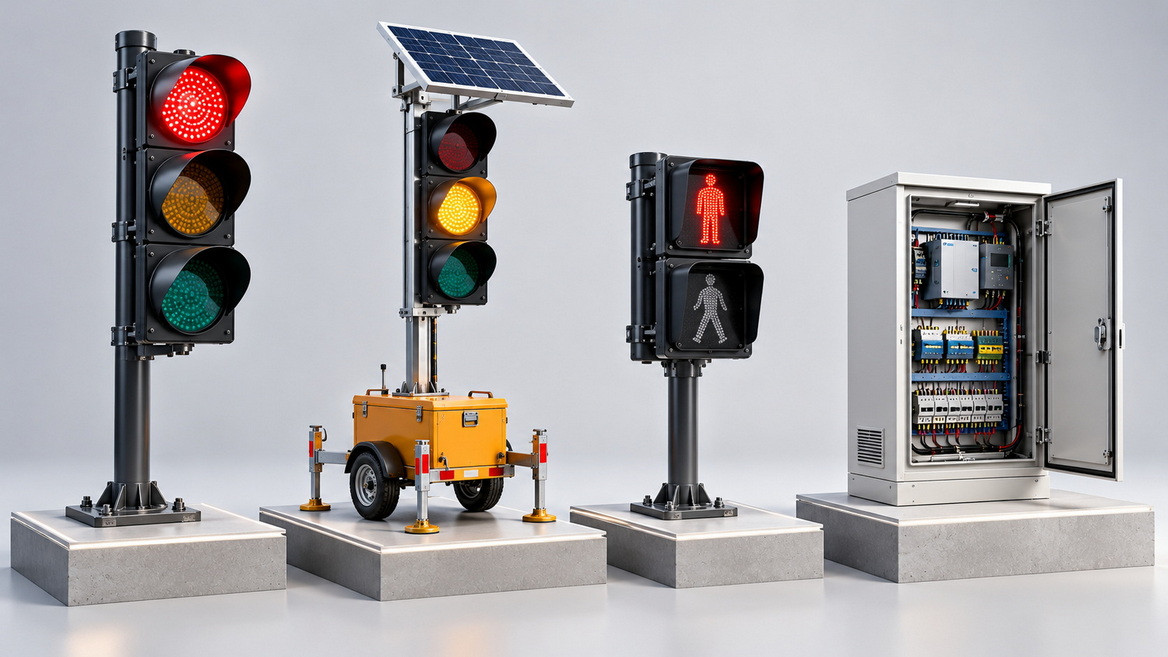
Public information does not provide a dependable, directly comparable monthly capacity figure for all ten companies. Inventing those figures would make the comparison less useful.
| Manufacturer | Public capacity information | MOQ visibility | Certification and documentation checks |
|---|---|---|---|
| XS Traffic | No independently verified monthly signal output | Low MOQ advertised; confirm quantity | Current ISO 9001 certificate and model-specific CE/RoHS documents |
| Sinowatcher | No comparable verified output figure | Confirm by model | Exact optical, electrical, and applicable compliance reports |
| FAMA | Industrial facilities described; output not independently verified | Project quotation required | Manufacturing-entity certificates and model reports |
| Qixiang | Reports over 200 employees; not an output measure | Numeric MOQ not established | Current certificates and destination-specific documentation |
| ZGSM | Testing capabilities described; output not verified | Advertises no MOQ limits; confirm exclusions | Claimed ISO certificates and applicable product documents |
| NOBLE | No comparable verified output figure | Confirm standard and custom orders separately | CE documentation and claimed ISO 9001 certificate |
| BBM | No comparable verified output figure | Confirm modules and complete signals separately | Optical, electrical, environmental, and compliance reports |
| Hisense TransTech | Project scale does not establish unit capacity | Contract-specific | Hardware, software, and system acceptance documentation |
| Hikvision | Group scale does not establish signal-line capacity | Confirm through commercial channel | Model compliance and integration documentation |
| Dahua | Group scale does not establish signal-line capacity | Confirm through commercial channel | Model compliance and system acceptance documentation |
Before issuing a purchase order, request available capacity for your delivery period, not simply a factory-wide annual production claim.
For relevant projects, EN 12368:2024 provides requirements for traffic signal heads and optical units.
Ask for evidence covering:
- Luminous intensity and angular distribution.
- Signal color performance.
- Luminance uniformity.
- Phantom signal behavior under external illumination.
- Relevant environmental and electrical requirements.
An indoor demonstration does not establish road visibility. A maximum brightness figure also does not describe the complete optical distribution.
Avoid vague specifications such as "premium plastic" or "high-quality aluminum."
Define material grade, permitted recycled content, UV-resistance requirements, wall thickness, gasket design, cable glands, and exposed-metal protection.
Requirements should reflect the installation environment. Coastal corrosion exposure, extreme temperatures, and maintenance practices can influence the appropriate design.
Solar panel wattage and battery amp-hours alone do not establish operating endurance.
Require a calculation covering:
- Site-specific winter solar conditions.
- Daily operating energy consumption.
- Controller and communication loads.
- Battery voltage and usable energy.
- Permitted depth of discharge.
- Temperature and aging allowances.
- Shading and installation orientation.
- Recovery after extended low-sunlight periods.
For permanent traffic control, define the required response to insufficient energy. A statement promising several cloudy days of operation is not a substitute for documented failure behavior.

Production units may use different components even when their appearance matches the approved sample.
Use an approved bill of materials, component traceability, and written change-control requirements. Critical substitutions should require buyer approval and, where necessary, renewed testing.
Check the report's model number, manufacturer, applicant, photographs, optical assembly, driver, and housing.
A report covering one signal configuration may not cover a different lens, power supply, or enclosure.
Separate the schedule into drawing approval, tooling, material procurement, assembly, testing, inspection, and dispatch.
A supplier that omits custom tooling or compliance testing from its schedule may be promising an unrealistic delivery date.
A working LED signal module can still fail acceptance when connected to the project's controller and monitoring equipment.
Bench illumination does not establish suitable off-state behavior, load monitoring, or fault detection.
Approve the operating combination—not only its individual components. Test the actual signal and controller configuration under the project's required conditions, including relevant disconnected-load, power-interruption, and fault scenarios.
This is especially important when replacing older signal modules or mixing equipment from different suppliers.
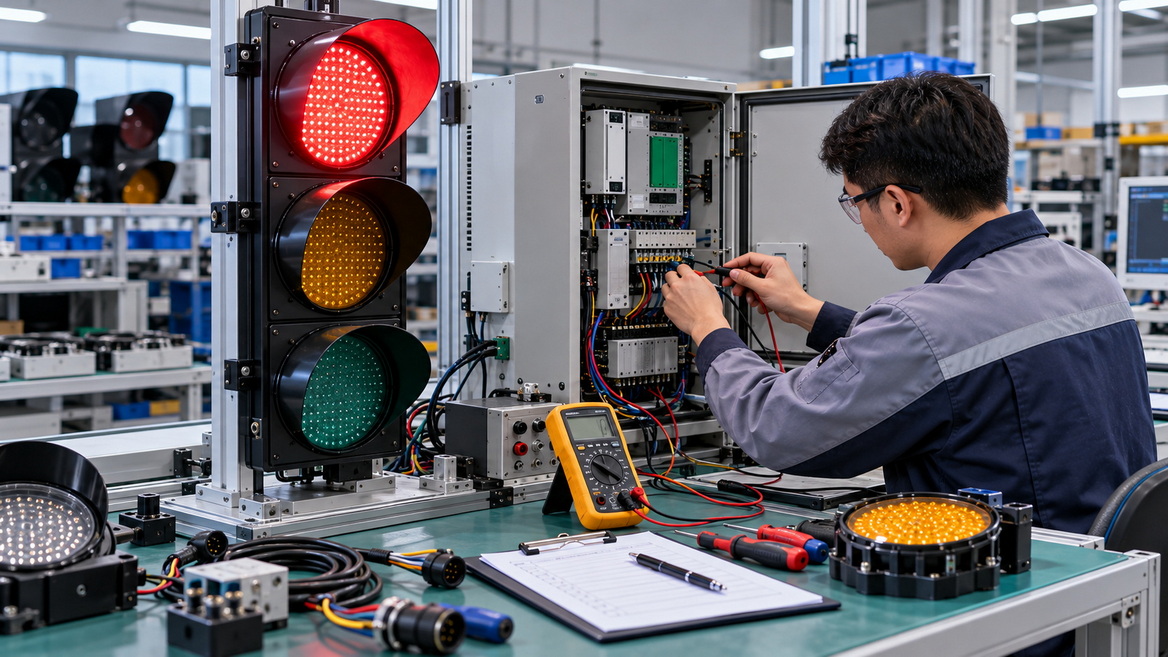
Use a staged purchasing process:
1. Verify the legal entity and manufacturing location.
2. Issue a specification identifying mandatory requirements.
3. Review compliance documents before custom development.
4. Approve drawings, interfaces, and the bill of materials.
5. Test engineering samples against measurable criteria.
6. Place a pilot order before a larger rollout.
7. Inspect units selected from the production shipment.
8. Confirm spare parts, installation documents, and warranty procedures.
9. Agree on shipment and import responsibilities in writing.
For solar products containing lithium batteries, request the applicable UN 38.3 test summary and consult a qualified forwarder.
Batteries shipped separately and batteries installed in equipment may require different transport arrangements. Confirm the actual shipment configuration before finalizing freight costs.
The right traffic signal manufacturer is the one that can consistently meet the project's technical, documentation, and delivery requirements.
XS Traffic is a relevant first contact for smaller brands and distributors seeking solar traffic safety products and flexible OEM customization. Sinowatcher, FAMA, Qixiang, ZGSM, NOBLE, and BBM offer different combinations of specialist hardware capabilities. Hisense TransTech, Hikvision, and Dahua are more relevant to integrated transportation systems.
To request a focused proposal from Shenzhen Xingsheng Traffic Facilities Co., Ltd., provide the installation country, application, signal size, power supply, controller interface, quantity, required standards, and customization drawings.
Ask for a quotation that separates standard equipment, engineering changes, testing, tooling, spare parts, and delivery milestones. A clearly defined proposal makes comparison easier and helps establish a more dependable long-term supply relationship.
Search the company name or certificate number through IAF CertSearch and check the status, scope, manufacturing location, and issuing certification body.
Verify directly with the issuer if information is missing or inconsistent. The certificate holder should match the relevant manufacturing operation, not merely an unrelated sales office or group company.
No. CE documentation does not replace the project specification or the approving authority's requirements.
Request the applicable declaration, exact model identification, supporting reports, and required performance classes. Establish which standards apply to the proposed configuration.
Approve a controlled bill of materials and require written authorization for critical changes.
Combine this with production traceability, inspection records, and shipment sampling. Retain a reference sample, but do not rely on appearance alone to identify substitutions.
Require all suppliers to use the same installation location, operating load, temperature conditions, battery assumptions, and reserve requirements.
Compare usable watt-hours rather than amp-hours alone. Evaluate charging recovery as well as discharge endurance.
Request battery identification, watt-hour rating, the applicable UN 38.3 test summary, and shipment configuration.
Have a qualified forwarder determine packaging, marking, documentation, and transport requirements. A safety data sheet alone does not establish UN 38.3 compliance.
Company websites provide supplier-stated information rather than independent factory audits. Confirm legal identity, certification validity, production capacity, and commercial terms before contracting.
1. [Shenzhen Xingsheng Traffic Facilities Co., Ltd.—Official Website]
Company-stated establishment date, traffic safety product categories, OEM/ODM positioning, and certification claims. [trafficthing]
2. [XS Traffic—Contact Information]
Supplier contact details and Shenzhen location. [trafficthing]
3. [Sinowatcher—Official Website] and [Intertraffic Company Profile]
Traffic control product portfolio, optical options, and company-reported international coverage. [trafficsolution]
4. [Sinowatcher—GoldSupplier Profile] and [Made-in-China Profile]
Public supplier information, including conflicting establishment dates requiring confirmation. [trafficsolution.goldsupplier]
5. [FAMA—Company History] and [Company Profile]
Shenzhen origins, Yangzhou development, and intelligent transportation positioning. [fama-tech]
6. [Qixiang Traffic Equipment—Company Profile]
Establishment and relocation dates, company-reported staffing, and OEM/ODM services. [yzqxtraffic]
7. [ZGSM—LED Traffic Signal Products]
Signal portfolio, OEM/ODM/SKD services, advertised MOQ policy, and certification claims. [zgsm-china]
8. [Shenzhen NOBLE Opto—Company Profile] and [Product Website]
Establishment date and traffic control product range. [solarradarsigns]
9. [BBM—Official Website] and [Public Supplier Profile]
Traffic signal specialization and inconsistent public establishment dates. [bbmled]
10. [China Daily—Hisense Smart Traffic Solutions] and [iF Design—Hisense Intelligent Traffic Command Platform]
Historical transportation deployment information and platform positioning. [chinadaily.com]
11. [Hikvision—Company Profile] and [Official Signal-Control Series]
Company background and traffic signal-control portfolio. [investing]
12. [Dahua—Company Background], [Intelligent Traffic Products], and [72-Channel Traffic Signal Controller]
Establishment information and official transportation product documentation. [en.wikipedia]
13. [Research and Markets—Traffic Signals Market Report 2026]
Published market estimates and forecasts; not Chinese export statistics. [researchandmarkets]
14. [EN 12368:2024—Traffic Control Equipment: Signal Heads]
Standard scope and traffic signal head performance requirements. [standards.iteh]
15. [U.S. Federal Highway Administration—Traffic Signal Program Handbook]
Government guidance on traffic signal program management. [ops.fhwa.dot]
16. [IAF CertSearch—Certificate Verification]
Accredited management-system certificate verification resources. [iafcertsearch]
17. [PHMSA—Transporting Lithium Batteries]
U.S. government guidance on lithium battery transportation and applicable requirements. [phmsa.dot]
18. [U.S. Department of Transportation—Check the Box for Lithium Batteries]
Battery shipping, packaging, and hazardous-material considerations. [transportation]


