
Please Choose Your Language
Views: 226 Author: XS Traffic Facilities Publish Time: 2026-10-10 Origin: Site


Content Menu
● Why Distracted Driving Requires More Than One Solution
● What LED Traffic Signs Can—and Cannot—Do
>> Pedestrian-Activated Warning Systems
● What the Evidence Says About Flashing Crosswalk Beacons
>> A Documented Example from St. Petersburg
● Selecting LED Traffic Signs for Different Road Environments
>> Streets and Pedestrian Crossings
● Beyond Roadside Hardware: Reduce Distraction at Its Source
>> Prepare Devices Before Driving
>> Make Workplace Policies Operational
● A Six-Step Plan for an LED Traffic Sign Project
>> 2. Record Baseline Conditions
>> 3. Confirm Applicable Requirements
>> 4. Select Power and Activation
>> 6. Review Results and Maintain the System
● What Buyers Should Specify for OEM and ODM Traffic Signs
● Turning Site Feedback into Better Product Requirements
● Frequently Asked Questions About LED Traffic Signs
>> Do LED Traffic Signs Prevent Distracted Driving?
>> Are Flashing LED Signs Suitable for Every Location?
>> What Is the Difference Between an RRFB and an LED Warning Sign?
>> Can Solar LED Traffic Signs Operate Through Cloudy Weather?
>> How Should Buyers Compare Traffic Sign Manufacturers?
LED traffic signs can make important road warnings easier to notice, but they cannot make distracted driving disappear. Their value comes from helping drivers recognize a relevant hazard and understand what to do next. For municipalities, highway operators, toll facilities, and parking managers, the challenge is choosing the right warning—not simply installing the brightest display.
At Shenzhen Xingsheng Traffic Facilities Co., Ltd., our focus is manufacturing traffic safety products for streets, highways, toll stations, and parking facilities, with OEM and ODM services for customer-specific requirements. This guide takes a manufacturing and procurement perspective: how to combine clearer warnings, responsible driver behavior, and practical project specifications without overstating what any single product can achieve.

Distraction includes anything that pulls attention away from driving. Texting is particularly dangerous because it combines looking away, handling a device, and thinking about something other than the road. Navigation adjustments, eating, and other activities can also interfere with attention.
U.S. national data recorded 3,208 deaths and an estimated 315,167 injuries in crashes involving distracted drivers in 2024. Eight percent of fatal crashes were reported as distraction-affected.
These figures describe crashes involving reported distraction. They do not establish that cellphone use caused every incident, nor do they measure the effectiveness of a particular warning sign.
The practical response is a layered approach:
- Reduce avoidable distractions before a journey.
- Establish clear workplace driving policies.
- Improve roadway visibility and crossing design.
- Use targeted warnings where drivers need to act.
- Measure performance after installation.
The central principle is relevance. A warning should communicate a specific hazard at a location where the driver still has time to respond.
LED traffic signs use light-emitting diodes to display a message or enhance the visibility of a conventional sign. However, different products perform different functions.
An LED-enhanced warning sign, a radar speed feedback display, and a pedestrian-activated beacon are not interchangeable. Each needs an appropriate application, operating strategy, and approval process.
LED-enhanced signs can draw attention to an established warning or regulatory message where their use is permitted. Potential applications include intersection approaches, school areas, and other locations identified through an engineering assessment.
The sign must remain recognizable. Illumination should support the message rather than compete with it.
Radar speed feedback signs display an approaching vehicle's measured speed. They provide immediate information that drivers can compare with the posted limit.
For buyers, the important questions include detection performance, display legibility, activation thresholds, and data capabilities. A speed display should not be presented as proof that a driver was distracted.
Pedestrian-activated systems connect the warning to an actual crossing request. Rectangular rapid flashing beacons, commonly called RRFBs, are one established treatment for suitable uncontrolled marked crosswalks.
Their purpose is to improve driver awareness and yielding. They do not remove the need to evaluate crossing distance, traffic speed, visibility, accessibility, and pedestrian demand.
Research provides useful support for RRFBs, but the results need careful interpretation.
Field studies have recorded driver yielding rates as high as 98 percent. Performance varies with location, posted speed, crossing distance, traffic direction, and the number of lanes.
That figure is an observed upper result—not a guaranteed outcome for every installation. It also describes yielding behavior, not a 98 percent reduction in crashes.
A federal study evaluated RRFB installations at 19 sites in St. Petersburg, Florida. At the two-year follow-up, yielding ranged from 72 to 96 percent at the studied locations.
The findings suggest that improved yielding can persist beyond the initial installation period. They do not establish that any flashing LED product will deliver the same results.
For procurement teams, the lesson is straightforward: match evidence to the specific device and application. Crosswalk beacon research should not be used to support unrelated claims about highway displays or parking signs.
Start with the decision a driver must make. Then determine which device, position, and operating method best support that decision.
| Environment | Driver decision | Potential solution | Key assessment |
|---|---|---|---|
| Urban street | Recognize a crossing or intersection hazard | Approved warning sign or crossing treatment | Sight lines, pedestrian activity, approach speed |
| School area | Respond to an active school-zone condition | Scheduled warning system | Operating hours, visibility, local requirements |
| Highway approach | Prepare for an upcoming hazard | Appropriate warning or changeable message system | Reading distance, message length, approval |
| Toll station | Select the correct lane | LED lane guidance or lane-status display | Decision distance, controller coordination |
| Parking facility | Follow circulation and pedestrian rules | LED guidance or warning signage | Low-speed visibility, turning paths, clutter |
These are application examples, not installation recommendations. The responsible road authority or project engineer should determine the appropriate treatment.
At a crossing, consider the whole environment rather than the sign alone. Parked vehicles, vegetation, curved approaches, and turning movements may prevent a driver from seeing pedestrians.
A conspicuous beacon cannot compensate for every visibility problem. Sometimes clearing an obstruction or changing the crossing layout is as important as adding illumination.
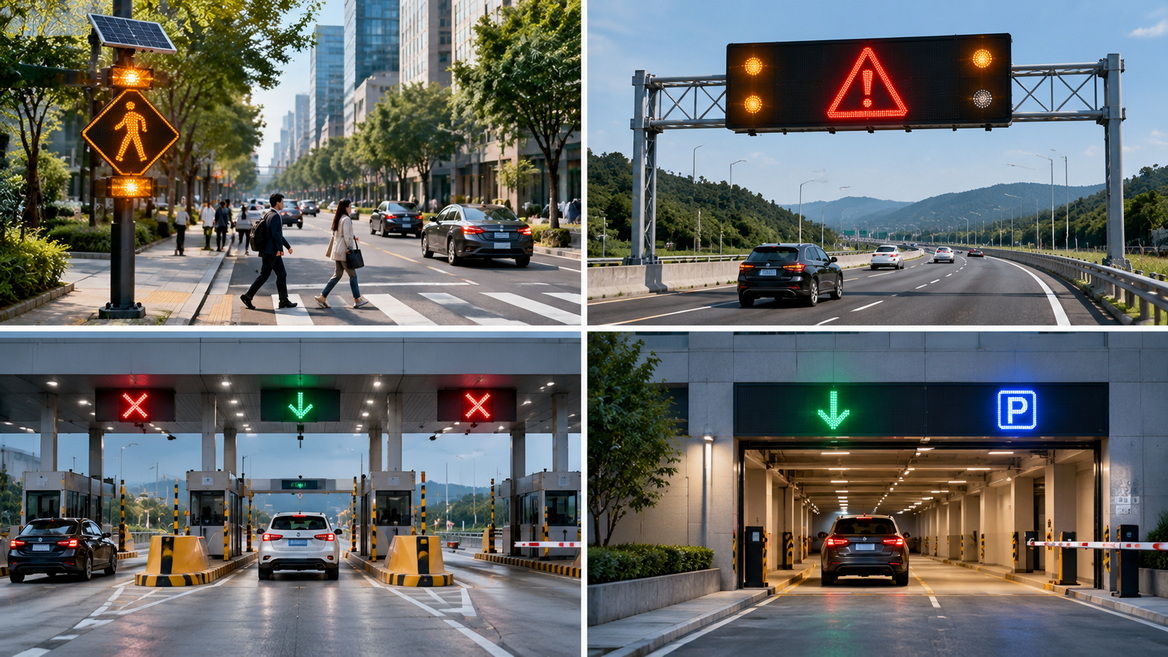
Higher-speed approaches demand earlier, clearer information. Toll facilities also require lane messages to agree with actual lane availability.
A bright display showing outdated information can mislead drivers. Controller integration, status verification, and fault handling therefore deserve as much attention as the display itself.
Parking facilities combine vehicles, pedestrians, reversing movements, and frequent turns. Keep instructions short and place them before the decision point.
Avoid surrounding an important warning with advertising or unnecessary illuminated messages.
Infrastructure is only one part of the solution. Drivers and employers can also reduce the circumstances that create distraction.
Drivers should set navigation, select audio, and configure distraction-reduction settings before moving. If an adjustment requires attention, stopping safely is preferable to attempting it while driving.
A mounted phone is not automatically distraction-free. The task still matters.
A company policy should cover more than employee behavior. Dispatchers and managers should avoid creating an expectation that drivers will answer messages immediately.
Useful policy elements include:
- No texting or handheld device use while driving.
- A clear procedure for returning calls after stopping.
- Journey preparation before departure.
- Consistent expectations for managers and contractors.
Telematics can support coaching by identifying patterns such as phone interaction or abrupt driving events, depending on the system.
However, harsh braking alone does not prove distraction. Review events in context, explain data collection to drivers, and avoid unsupported conclusions.
A successful project begins before the quotation. A clear brief helps suppliers propose an appropriate configuration and makes competing offers easier to compare.
Describe the behavior you want to address: late lane changes, poor yielding, missed warnings, or excessive approach speed.
Avoid defining the problem as "we need a brighter sign." That describes a preferred product feature, not the underlying safety issue.
Collect relevant observations before installation. Depending on the project, these may include:
- Vehicle speeds and traffic volumes.
- Pedestrian yielding rates.
- Lane-choice errors.
- Daytime and nighttime visibility.
- Existing sign locations and obstructions.
Identify the destination market and responsible approving authority.
For U.S. road projects, review the applicable Manual on Uniform Traffic Control Devices requirements and any state or local provisions. Other markets require their own standards and approval checks.
Customization does not override these obligations.
Compare mains-powered and solar-powered options against actual site conditions.
Specify whether the system operates continuously, follows a schedule, responds to a pedestrian request, detects an approaching vehicle, or receives commands from another controller.
Verify visibility from the intended approach lanes during daylight and darkness. Check that mounting, orientation, activation, and controller behavior match the approved design.
Include power-loss and communication-failure scenarios where relevant.

Repeat baseline measurements under reasonably comparable conditions. Record equipment faults and maintenance activity alongside behavioral results.
Do not attribute every change to the new sign. Traffic volume, enforcement, weather, and other site changes can influence outcomes.
For an OEM project, buyers generally provide the required design or specifications. An ODM project may involve supplier-supported development. In either case, responsibilities should be documented clearly.
| Specification area | Questions to resolve |
|---|---|
| Sign design | What dimensions, symbols, colors, and layouts are required? |
| LED operation | What brightness control and permitted operating pattern are needed? |
| Power supply | What voltage, consumption, and backup requirements apply? |
| Solar configuration | What solar resource, shading, and autonomy assumptions are used? |
| Environmental protection | What verified ingress, temperature, and corrosion performance is required? |
| Integration | What interfaces, protocols, and fault states must be supported? |
| Documentation | What drawings, test reports, instructions, and spare-parts information are needed? |
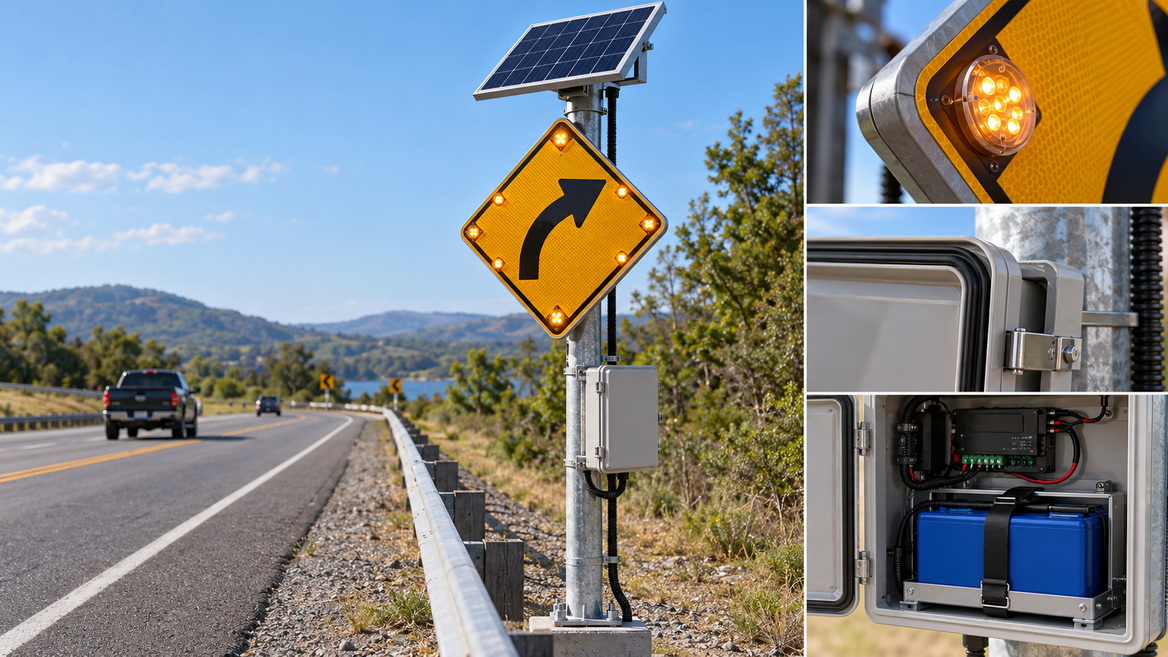
Do not treat LED count or a high ingress-protection rating as a complete quality assessment. Neither demonstrates message legibility, suitability for the site, or approval for a particular jurisdiction.
For solar LED traffic signs, request the energy-sizing assumptions. Battery autonomy should relate to the operating schedule and local conditions—not an unexplained marketing figure.
User feedback becomes valuable when it describes an observable problem.
No customer reviews were supplied for this article, so the following are illustrative feedback categories, not testimonials or reported customer experiences.
- "The warning appears too late" calls for an approach-distance review.
- "The display is uncomfortable at night" calls for a brightness and aiming assessment.
- "The system loses power during poor weather" calls for an energy and maintenance investigation.
- "Drivers choose the wrong lane" calls for a message-placement and coordination review.
Convert each observation into a testable requirement. Instead of requesting "better visibility," define the approach lane, viewing conditions, message, and acceptance method.
This creates a stronger connection between the buyer's operational problem and the manufacturer's design work.
Not by themselves. They can improve the conspicuity of a relevant warning, but they cannot ensure that drivers pay attention. Combine appropriate infrastructure with responsible device use, workplace policies, and other road-safety measures.
No. Suitability depends on the sign type, road environment, operating pattern, and applicable requirements. Unnecessary flashing can add visual clutter. Select the treatment through an appropriate assessment rather than using the same configuration everywhere.
An RRFB is a specific pedestrian-crossing treatment using rapidly flashing rectangular amber indications. An LED warning sign is a broader product category. They have different functions, design requirements, and evidence bases.
They can be designed with battery storage for periods of limited sunlight. Actual performance depends on energy demand, solar availability, shading, temperature, battery condition, and the specified autonomy target. Request a documented sizing calculation for the site.
Compare application suitability, documented specifications, manufacturing consistency, test evidence, integration support, and maintenance provisions. Price matters, but quotations are only comparable when their technical scope and included services are clear.
1. Carmanah Technologies. "A Cure for Distraction: How Cities and Companies Are Thinking Outside the Box to Curb Distracted Driving." Original article dated January 7, 2020; the page also displays November 1, 2024. Source for the original multi-layered countermeasure framework. Its older statistics and company-reported app results were not reused as current evidence. [carmanah]
2. National Highway Traffic Safety Administration. "Distracted Driving Dangers and Statistics." Source for the definition of distraction, practical prevention guidance, and 2024 figures of 3,208 fatalities and 315,167 estimated injuries. [nhtsa]
3. National Highway Traffic Safety Administration. "Distracted Driving in 2024," publication DOT HS 813 790. Source for the distinction between reported distraction-affected crashes and cellphone-related distraction, and the finding that eight percent of fatal crashes involved reported distraction. [crashstats.nhtsa.dot]
4. Federal Highway Administration. "Rectangular Rapid Flashing Beacons (RRFB)." Proven Safety Countermeasures resource. Source for application considerations, observed yielding rates up to 98 percent, and factors affecting performance. [highways.dot]
5. Federal Highway Administration. "Effects of Yellow Rectangular Rapid-Flashing Beacons on Yielding at Multilane Uncontrolled Crosswalks." Source for the St. Petersburg evaluation, including 19 installations and yielding rates of 72–96 percent at the two-year follow-up. [fhwa.dot]
6. Federal Highway Administration. "Comparison of Driver Yielding for Rectangular Rapid-Flashing Beacons Used Above and Below Pedestrian Crossing Signs." Source for field-study variability and the importance of distinguishing observed yielding outcomes from universal performance guarantees. [fhwa.dot]


